Sunday, January 29, 2012

Why does this song make me miss Korea?

I don't know, but it reminds me of the Korea I knew in the 1980s, of which I have very good memories.


The Lyrics:
거꾸로 강을 거슬러 오른 저 힘찬 연어들처럼

1 흐르는 강물을 거꾸로 거슬러 오르는 연어들의 도무지
알수 없는 그들만의 신비한 이유처럼 그 언제서 부터인가
걸어걸어걸어 오는 이길 앞으로 얼마나 더많이 가야만 하는지

2 여러 갈래중 만약에 이길이 내가 걸어가고 있는 돌아서
갈 수밖에 없는 꼬부라진 길일지라도 딱딱해진 발바닥
걸어걸어걸어 가다보면 저 넓은 꽃밭에 누워서 난 쉴수 있겠지

3 여러 갈래중 만약에 이길이 내가 걸어가고 있는 막막한
어둠으로 별빛조차 없는 길일 지라도 포기할순 없는거야
걸어걸어걸어 가다보면 뜨겁게 날 위해 부서진 햇살을 보겠지

4 그래도 나에겐 너무나도 많은 축복이란걸 알아 수없이
많은 걸어 가야할 대 앞길이 있지않나 그래 다시 가다보면
걸어걸어걸어 가다보면 어느날 그 모든 일들을 감사해야 하겠지

RAP :
보이지도 않는 끝 지친어깨 떨구고 한숨짓는 그대 두려움 알아요
거꾸로 강을 거슬러 오르는 저 힘찬 연어들 처럼
걸어가다보면 걸어가다보면 걸어가다보면...

Sunday, July 31, 2011

Does Heaven repay those who bury 2-headed snakes?

"The Tale of the Two-headed Snake"

When Son-suk Oh (孫叔敖) was a young child (為嬰兒), he went out to play (出遊), but when he returned (而還), he was upset (憂) and would not eat (而不食). His mother (其母) asked (問) the reason (其故).

While crying (泣而), he answered (對曰),"Today (今日), I saw (吾見) a 2-headed snake (兩頭蛇), so I fear (恐) I have no days left before going to death (去死無日矣).

His mother asked (母曰), "Now (今), where is the snake (蛇安在)?"

Answering (曰), "I heard (吾聞) a person who sees a 2-headed snake (見兩頭蛇者) dies (死). I feared (吾恐) others (他人) would also see (又見), so I have already (已) buried it (埋之矣).

His mother said (母曰), "Don't worry (無憂). You won't die (汝不死). I have heard that (吾聞之) if there are those who do good secretly (有陰德者), Heaven (天) repays them (報) with blessings (以福).
-------------------

孫叔敖為嬰兒出遊而還憂而不食其母問其故泣而對曰今日吾見兩頭蛇恐去死無日矣母曰今蛇安在曰吾聞見兩頭蛇者死吾恐他人又見已埋之矣母曰無憂汝不死吾聞之有陰德者天報以福

Friday, July 22, 2011

Is Puberty a Good Time to Start Learning Korean?

A seventh grade girl is attracted to a Korean-American boy and starts learning Korean. Four years later, she becomes the first "non-Korean" to win second place in a Korean speech contest hosted by the U.S. National Association for Korean Schools. Then, after a phone interview with a Korean reporter, the girl is described by the reporter as being able to speak Korean as if it were her mother tongue.

Four years may seem like a long time to learn a language, but when learning Korean, it is not that long, especially if you are trying to learn it outside Korea.

Link to Article

And she is very good.


Saturday, July 16, 2011

"If I were a leaf," by Gerry Bevers

If I were a leaf, I'd want to be
One of a sprawling sycamore tree.
Then under my soulful, silent shade,
Young and old could drink pink lemonade.

Summer showers go splitter splatter,
But under me it would not matter.
My friends and I would be broad and green,
Stopping the raindrops while staying clean.

Thursday, July 07, 2011

How do Koreans say "to pass the buck"?

The American idiom "to pass the buck" is translated in Korean as 책임을 전가하다. 책임(責任) means "responsibility," and 전가(轉嫁) means "to impute" or "to attribute."

What I find interesting about the Korean expression is that 전가(轉嫁) also means "to remarry" on the part of a woman. The Chinese characters literally mean "transfer the wife's marriage."

Unloading your wife onto the back of another man seems like a perfect example of "passing the buck."

Monday, June 20, 2011

Are you a Hypocrite or a Good Deed Doer?

Confucius wrote:
Heaven repays a person who does good with blessings and a person who does bad with calamity. 
 爲善者天報之 以福,  爲不善者天報之 以禍 (위선자천보지이복, 위불선자천보지이화)
爲善者(a do good person) 天報之(Heaven repays him) 以福 (with blessings),  爲不善者(a do no good person) 天報之(Heaven repays him) 以禍 (with calamity).
Based on the above Confucian saying, 위선자(爲善者) can be translated as "a good deed doer," so why do modern day Koreans use 위선자(僞善者) to mean "hypocrite"?

The answer lies with the Chinese characters for 위. Notice that the Chinese character for the 위(爲) in "good deed doer" is slightly different than the 위(僞) in "hypocrite." 爲(위) means "do," but 僞(위) means "lie, pretend" The other two characters are exactly the same: 善 (선 - good), 者(자 - person). Therefore, the Korean word for "hyprocrite," 위선자(僞善者), literally means "a pretend good person."

The next time someone calls you a 위선자, you can reply, "Really? I guess that means I can expect blessings from Heaven."

Sunday, June 19, 2011

"The Cycle of Life," by Gerry Bevers

At Seventy-two or fifty-three,
The Angel of Death is eyeing me.
I do not fear him for I know,
Like flowers and trees, we all must go.

Back to the earth from which we came,
Your dirt and my dirt will be the same.
Our lives as humans may come to an end,
But another awaits just ‘round the bend.

I may come back as a tomato plant,
Or if I’m lucky, a giant elephant.
Life eternal would be a bore,
Nature offers much, much more.

Tuesday, March 01, 2011

How would you translate 란/이란 in English?

란/이란 is a topic marker similar to 은/는 that attaches to nouns, but is more emphatic than 은/는. It is an abbreviation of (이)라는 것은. The marker 란 attaches to nouns that end in a vowel (eg. 친구란), and the marker 이란 attaches to nouns that end in a consonant (eg. 가족이란).

The marker essentially announces that you are about to define or explain the noun to which it is attached, as the following example shows.
친구란 어려울 때 도와줄 수 있는 사람이에요.

A friend is someone who helps you in difficult times.
Dictionaries often show "as for" as an English equivalent of 란/이란, but normally we would not translate it in English. However, in spoken English, we usually show the emphatic nature of the marker by stressing the noun to which 란/이란 is attached and then pausing before continuing on with the definition or explanation of the noun, as demonstrated below:
A friend--is someone who helps you in difficult times.
In the above example, the boldface type is meant to indicate stress, and the hyphens (dash) are meant to indicate a pause.

Normally, Koreans also pause after the marker 란/이란 before continuing on with the definition or explanation of the word or phrase to which it is attached.

Saturday, February 26, 2011

"Raising Boys," by Gerry Bevers

Twelve year old boys can surprise,
Not as innocent as some surmise.
To a young boy in the spring,
Girls can be a curious thing.

Discarded magazines were the way,
We learned of girls back in my day.
Now the Internet is the teacher,
The female body, the main feature.

Don't trust your son with a computer,
For it can be a mind polluter.
The female body is quite beautiful,
But some sites are just not suitable.

Monday, February 14, 2011

"Genesis" -- by Gerry Bevers

Our God is the Sun,
the creator of life,
the sustainer of life.

His essence is Hydrogen,
the smallest of seeds,
the source of all matter.

Hydrogen begets Helium,
and Helium begets Carbon,
with whom Hydrogen bonds
to give birth to all living things.

The God of our God is Gravity,
the unseen Force of the universe
that brings it all together.

Thursday, February 10, 2011

"Snowy Night" by Gerry Bevers

Just beyond my window pane,
Gently falls white winter rain.
Fluffy flakes floating down,
Softly landing without sound.

As my world waxes winter white
Reflecting stars and soft moonlight,
The silent sadness of the lonely night
Fades away into soft delight.

Friday, January 28, 2011

"Please" by Gerry Bevers

I'm battening down the hatches.
And fastening all the sashes.
I just want to be left alone.

Please ask me no questions.
Please make no suggestions.
I just want to be left alone.

No need to worry,
Or to feel sorry.
I just want to be left alone.

I'm not at all bitter,
Just things to consider.
So, please just leave me alone.

Wednesday, November 17, 2010

"Safety First," by Gerry Bevers

‎"Safety First"

Feel my groin,
Give it a squeeze.
Just don't snicker, please.

Feel her breasts,
And check the rest.
Please do not caress.

Let's fly safe;
Rather be late,
Then the news at eight.


by Gerry Bevers

Thursday, November 11, 2010

"Young Heroes," by Gerry Bevers

"Young Heroes"

Young, patriotic, and full of life, 
They join to fight for what is right. 
With a big smile, a hug and a kiss, 
They say "Goodbye" and then say this: 

 "Don't worry about me. I'll take care." 
"I'll return to you from over there." 
When the sad news comes, it makes us cry. 
Now with God, they never meant to lie. 

 by Gerry Bevers

Tuesday, October 12, 2010

A snake 40 to 50 feet long in Korea?

Did you know the Japanese supposedly found and killed a snake between forty and fifty feet long (4, 5 jang – 丈) in Hamheung, Korea in 1906? One jang (丈) is supposed to be ten cheok (척 - 尺), and one cheok is supposed to be about one foot. In pure Korean, cheok (척 - 尺) is written as 자.

The Japanese supposedly burned the snake, which caused a stench so bad that seven Japanese soldiers died that night after vomiting up blood.

Thursday, February 18, 2010

Korean Phychologist Suggests Apolo Ohno "Abnormal" and "Immature"

The Dong Ilbo, which is one of Korea's big three newspapers, has posted an article entitled, "Ohno's Spiteful Actions, Result of Immaturity and Lack of Love?," in which a Korean phychologist suggests that Ohno's "spiteful actions is a result of immature and excessive self devotion and a lack of love."

I will translate the article when I have more time.

Korean Media Distorts Apolo Ohno's Statements

Ever since Apolo Ohno won the silver medal in men's 1,500 short-track on February 13 at the 2010 Vacouver Winter Olympics, the Korean media has been conducting a vicious, unfair smear campaign against Ohno. The Korean media is not only describing Ohno in hateful, unfair language, but they are misquoting and distorting his statements to the English media.

The following is a February 16, 2010 SBS News report on Ohno. It is typical of what is being said in much of the Korean media. SBS NEWS is one of the three big news organizations in Korea.
--------------------------

Anchor: Apolo Ohno, who was the “undeserving” (implied – 어부지리) winner of a silver medal in Men’s 1,500-meter short-track, has made another ridiculous claim that has aggitated our athletes.

Even though he had clearly committed an illegal action, he has made the ridiculous claim that he lost the gold medal because of the interferrence of our athletes.

Reporter Jeong Gyu-jin covers it in Vancouver.

[Reporter]

This is a scene from the men’s 1,500 meter race.

A scene of Ohno grabbing and tugging on the left arm of Seong Si-Baek, as Ohno wedged his way in at the inside corner, has been clearly captured on camera by the SBS crew. The situation lasted close to three seconds.

During the semi-finals, he also used his arm to push Lee Jeong-su, which caused Lee Jeong-su to show an expression of surprise.

Even though these are the facts, in an interview with American media, he said if Korean athletes had not impeded my way, the results could have been a lot different. He also claimed that he had never once grabbed another competitor.

After having said immediately after the race that he had hoped Korean athletes would be disqualified, he is once again aggravating our team.

However, it has become known that he has acknowledged the thoughtlessness of the irratating hand gesture he made after winning the race as a result of our athletes crashing into each other.

[American Short-track Team Coach Jeon Jae-su: It was extremely unsportsmanlike behavior, so I angrily scolded him immediately after the race. And, actually, Ohno has been greatly reflecting on that part, and said he does not know why he did it.]

After causing waves with his statements, Ohno has refused interviews while showing a consistent, hardened expression throughout practice.

Analysts think Ohno’s statement shows that he intends to use scuffles during the remaining races to get favorable judgements.

Notice that SBS News did not use any quotation marks in their report, but other news outlets reporting on the SBS report did. For example, Newsway quoted Ohno as saying the following:

I have never interfered with another athlete by grabbing his arm or leg and holding on for so long.

“나는 한번도 어떤 선수의 팔이나 다리를 이처럼 오랫동안 붙잡아 방해한 적이 없다”

First, both news reports are misquoting Ohno. Ohno did not say he had never "held another athlete's arm or leg"; he said his arm or leg had never been held by another athlete for so long. HERE is what Ohno said:

I definitely don’t think it’s typical, not in my sport. I’ve never had anyone hold onto my leg or arm that long. If it weren’t for that, the outcome would have been much different.

I started to pass one of the Korean skaters on the inside, and he put his left hand over and blocked me. That’s when I lost a lot of my speed.

The (earlier) bump allowed the others to catch up. That’s short track. When I saw those two guys lining up to pass on the final lap, I knew something was going to happen. It was a mistake on their part, and worked in my favor.

Everyone wants to win, and gets caught up in the emotions. All three of those Korean skaters are tough and strong. It was one of the hardest races I’ve skated in.

I do not know what Ohno meant by his hand gesture, but I know it to mean “stop,” as in “stop doing something.”

I do not know why Ohno’s Korean coach said what he did to the Korean media, but since the Korean coach did not make a similar declaration to the English media, I am suspicious. Ohno’s Korean coach seemed to be feeding Korea’s hatred for Ohno, not appeasing it. I wonder if Ohno even knows what his coach told the Korean media?

SBS News was trying to make Koreans believe that Ohno had cheated by grabbing the Korean skater's arm, but it you watch the SBS VIDEO, you will see that it was the Korean who grabbed and held on to Ohno's knee until Ohno finally knocked his arm away. That allowed the Korean skater's teammate to skate around on the outside. Watch the video and judge for yourselves.

Wednesday, February 03, 2010

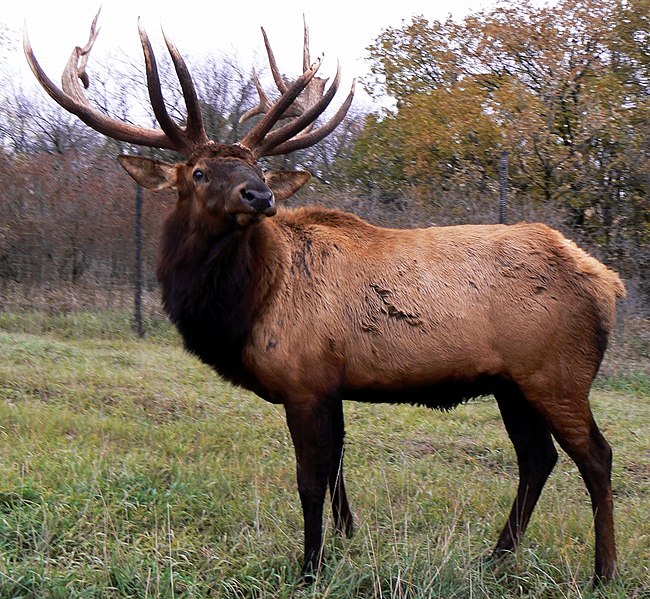
How do you say "elk" in Korean?

My dictionary says elk is 말코손바닥사슴. A deer with a horse's nose and hoofs? UPDATE: 말코손바닥사슴 is the Korean word for "moose," not elk. The word is descriptive since 말코 means "horse nose" and 손바닥 means "palm," which most likely refers to the palm-shaped antlers of the moose. 사슴 means "deer."
Photo of a moose from Wikipedia
The Korean word for elk seems to be 와피티사슴, which comes from the Korean transliteration of "wapiti" (와피티), another name for "elk."
Photo of an elk from Wikipedia
.
By the way, can anyone count how many elk are in the following video?