Tuesday, November 30, 2021


What does 슈퍼 트루퍼 mean?
ANSWER: Super Trouper
슈퍼 투루퍼 조명이 비추면
슈퍼 트루퍼 조명이 비춰도 우울했지만
오늘은 달라 당신이 와 있으니까
어제 네게 전화했을 때
너무 힘들고 지쳤었지
내 생활은 의미도 없고
공연도 하기 싫었었지
헌데 너 온다니 얼마나 기쁜지
갑자기 좋아졌어
오늘밤 공연은 아주 다른 무대 될 거야
오늘밤 슈퍼 투루퍼
태양처럼 밝은 조명 비추니
나는 즐거워 최고라 느껴지니까
언제나 슈퍼 트루퍼
조명이 비춰도 우울했지만
오늘은 달라 당신이 와 있으니까
많은 친구 곁에 있어도
사람들은 외로워 하네
하지만 나는 그렇지 않아
나에겐 당신 있으니까
가끔 그럴때가 서성댈 때가 있었어
허나 이젠 괜찮아
오늘 밤 공연은 아주 다른 무대 될거야
오늘 밤 슈퍼 투루퍼 태양처럼 밝은 조명 비추리
나는 즐거워 최고라 느껴지니까
언제나 슈퍼 투루퍼 조명이 비춰도 우울했지만
오늘은 달라 당신이 와 있으니까
당신 여기 도착했어
나를 꼭 안아주면 아직 내가 살았음을 느낄 수 있어
안아주면 오늘은 특별한 밤 될 거야
오늘 밤 슈퍼 투루퍼 태양처럼 밝은 조명 비추리
나는 즐거워 최고라 느껴지니까
언제나 슈퍼 투루퍼 조명이 비춰도 우울했지만
오늘은 달라 당신이 와 있으니까
슈퍼 투루퍼 조명이 비추면
Thursday, November 18, 2021
What does 乒乓兵 (병병병) literally mean?
ANSWER: ping-pong (乒乓) soldier (兵)
핑퐁 (乒乓) is a Sino-Korean word that refers to the game "ping-pong," or table tennis, even though my Korean-English dictionary does not show it as a Sino-Korean word. Koreans also refer to the game as 탁구 (卓球). Both 핑 (乒) and 퐁 (乓) are sounds that are made when striking objects, similar to the sounds made when hitting ping-pong balls. They both can also be pronounced as "병," so 병병 (乒乓).
The Chinese character 兵 (병) means "soldier," so 병병병 (乒乓兵) or 핑퐁병 (乒乓兵) can literally translate as "ping-pong soldier." I am reminded of the character Forrest Gump in the movie "Forrest Gump."
 |
| From Dong-A's Prime Korean-English Dictionary |
 |
| From Naver's Chinese Character Dictionary |
Sunday, November 14, 2021
What does 부부읍읍 (阜阝邑阝) mean?
ANSWER: the "hill" (阜) 부 (阝) [or] the "town" (邑) 읍 (阝)
The Chinese character 阜 (부), by itself, means "hill" (언덕), but it is also used as a radical (부수 部首), which means it is used to form and index other characters with meanings that are somehow related to "a hill." But when it is used as a radical, it is written as 阝(부), as in the Chinese character 陵 (릉), which means "hill," "mound," or "tomb." In fact, it is more often used in its radical form than in its individual character form.
The Chinese character 邑 (읍) means "town," but it is also used as a radical, and its radical form is written as 阝(읍), the same form in which the radical for 阜 (부) is written. So if the radical forms of 阜 (부) and 邑 (읍) are both written as 阝, then how can you tell them apart?
Well, if 阝 is on the left side of a character, then it is the "hill" 阜 (부) radical, as in 陵 (릉), which means "hill," "mound," or "tomb," but if it is on the right side of the character, then it is the "town" 邑 (읍) radical, as in the character 都 (도), which means "capital city."
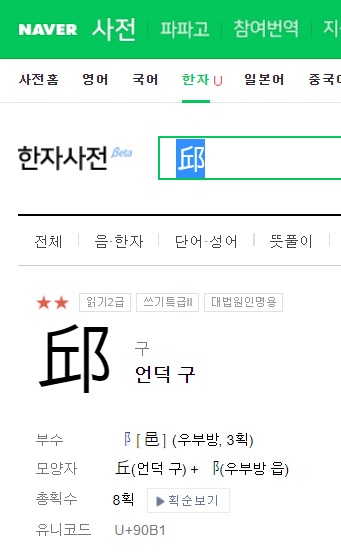
But I still have one question: Why is 阝 written on the right side of the character 邱 (구) instead of on the left side, given that 邱 (구) means "hill" (언덕) or "mound"? Does anyone know the reason? Anyway, since the 阝 is written on the right side of 邱 (구), the character is listed under the "town" radical (邑 읍) instead of under the "hill" radical (阜 부), even though the character itself means "hill." That seems a little strange, doesn't it?
 |
| From Naver's online dictionary |
Monday, November 01, 2021
What is the English translation of 릴리 마렌?
ANSWER: "Lili Marleen"
"Lili Marleen" is the name of a German love song that became popular during World War II. It has been translated into many languages, and here is a Korean version, sung by 이연실
릴리 마렌, by 이연실
병영 막사 앞에 서있는 등불은
오늘도 변함없이 불타오르는데
나 이제 홀로 그리움에
그 자리를 찾아왔네
음 ~ 릴리 마렌 음 ~ 릴리 마렌
우리의 그림자는 하나가 되어
밤안개 속으로 길게 비추이고
즐거운 그대 웃음에
모두 걸음을 멈추었지
음 ~ 릴리 마렌 음 ~ 릴리 마렌
모두 걸음을 멈추었지
음 ~ 릴리 마렌 음 ~ 릴리 마렌
우리를 지켜주던 그 가로등빛은
그대 오는 소리를 잘 알고 있었지
내겐 슬픔이 생겼어
누군가 그대와 함께 섰네
음 ~ 릴리 마렌 음 ~ 릴리 마렌
아득한 꿈처럼 그대 입술은
내 가슴속에서 떠나질 않는데
안개가 밀려오는 밤
누군가 그대와 함께 섰네
음 ~ 릴리 마렌 음 ~ 릴리 마렌
Subscribe to:
Posts (Atom)