Friday, June 19, 2009

What ever happened to Peter H. Lee?

Peter H. Lee was my Korean Literature professor at the University of Hawaii in 1981-2. I think I had two classes with him. Including me, there were only about four students in each of the classes. We just sat around a small table and talked about the Korean short stories we had read.

[A portrait of the scholar as a young man-the year Peter H. Lee completed his M.A. at Yale University. (Summer 1953 in New Haven, CT)]

The class was very informal and not very instructive. Professor Lee just seemed to be there to listen to us talk without offering much of his own insight. Quite honestly I was disappointed with the classes because I had expected more insight and instruction from the professor, who was supposedly a leading scholar in his field. However, maybe his style was to wait for us to ask the questions. The problem with that style, however, was that we did not know enough to ask questions.
Maybe he just sat there listening because he did not see much reason explaining Korean literature to students who needed, at least, a full afternoon to read one Korean short story. Anyway, besides reading a few Korean short stories, the only thing I really learned in those classes was how to quickly flip back and forth through a Korean-English dictionary.

Even though I do not remember learning much in his classes, I still liked Professor Lee. He was a quiet, dignified man who seemed old and grandfather-like even back in 1981. I remember his speech being slow and deliberate and his voice being kind of squeaky and high pitched, but there was usually a smile in front of it. I also remember his telling us that he learned English by memorizing a dictionary. He said that after he had memorized a page in the dictionary, he tore it out. I do not remember if he said he threw it away of if he said he put it on the wall and ceiling over his bed, but he did say that he tore the pages out.

So, why am I writing about Peter H. Lee? Because I suddenly started thinking about him this morning and wondering what happened to him. I went to Wikipedia expecting to find an article on him, but there was nothing there, which bothered me since I feel he deserves to be recognized and remembered. Then, I did a Google search and found an article in the 2007 edition (Vol. 1) of the journal, "Azalea: Journal of Korean Literature." I was happy to read that he is alive and well.
Even though you can read the article in the link I provided, I am going to post the entire article here as a tribute to Professor Lee, in case the journal decides to remove the article for some reason. I will keep it posted until I get an email from the journal or the author telling me to take it down, but I hope they do not mind. In my opinion, the more places and opportunities there are for people to read Peter H. Lee's story, the better.


[End Page 370]

This interview was conducted on March 6, 2007, and took several hours from late morning to mid-afternoon at the Faculty Center at the University of California, Los Angeles. Prof. Peter H. Lee has been a faculty member at the university since 1987. Academics in Korean studies outside Korea know Peter H. Lee as the resilient, meticulous scholar who is mostly responsible for establishing the field of Korean literature in the English-speaking world. However, in this interview he reveals a glimpse of his personal life, rich with encounters and experiences.

Mickey Hong: What were your memories of childhood? What colors, smells, and sounds do you remember? What did people wear? What did you wear? What kinds of food and drink were popular?

Peter H. Lee: I don't really remember colors, except those of girls' dresses. Smells and sounds, I think, are quite important because smells can be good or bad, and some are exotic. When I was about five, my grandfather took me to Mitsukoshi department store to buy me a school uniform. Back then you had two uniforms: one for winter and spring, and another for summer and maybe early [End Page 371] autumn. So that was the first time I set foot in Mitsukoshi, which was across the street from the Bank of Korea, Chōsen Ginkō. When I entered the building, I smelled a strange but pleasant odor, unlike any I was used to. It was a combination of perfume, naphthalene, and other scents. From then on I always associated that odor with Japanese stores. It struck me as strange because I had never smelled anything like it. But when I went to Hwasin later on, there was a similar smell, though not as strong.

When my father took me to a Japanese restaurant, again I encountered an odor different from what I was used to at home-maybe a combination of Kikkoman shōyu and other Japanese condiments. We never used shōyu. We used homemade Korean-style soy sauce. Also you could tell the difference because if you add Japanese shōyu, the soup becomes dark. I didn't like that. In the restaurant I encountered a second unusual odor, very different from the Korean odors at home. Although I wasn't allowed into the kitchen, the aromas wafted out and I could tell what they were cooking-beef soup, roast fish. But the smells from Mitsukoshi and the Japanese restaurant were different.

Our family occasionally went to a restaurant on the third or fourth floor of Hwashin department store where I experienced other smells-of curry rice, omelet rice, and some Western dishes. I think I first ate a Western-style sandwich in August 1945 in a Chongno restaurant. Other sounds and smells struck me as a child at the Chongno night market (yasi before 1945) with its many brightly lit stalls and ocean of people. Some fruit stalls sold exotic items like bananas and pineapples!

In Honmachi (Ponjŏng, what is now Myŏngdong), the Japanese area, there was a small store owned by a White Russian that sold butter, cheese, and bread. I was ten or eleven when I was sent there by my father or aunt to buy some bread and butter. When I walked into that store I encountered an entirely different odor. A very different odor. And I met the White Russian, who had a lot of hair.

Out in the street, different smells mingled, of food, people [End Page 372] passing by, tram cars, buses. Tram cars had a distinctive smell, as did buses. When I rode in a taxi (an old Volvo, as I recall), there was yet another smell.

On the top floor, the fourth or fifth, of Hwasin department store, there was a small cinema that showed films primary and secondary school students could watch. I went there occasionally to see Japanese films, which always began with newsreels. Some of these films were quite good. Inside the movie house there was another odor, one that I cannot begin to describe.

Back then, educated persons, the intelligentsia, all wore Western suits. Old people still wore kat and Korean costume. Even up to the mid-1930s, I rarely saw mature women wearing Western-style skirts and shoes. That was rare, but in the late 30s you did see some women with short hair or permanents wearing Western dresses and carrying handbags. The men, the intelligentsia, however young-if they were at least thirty and if they could afford it-normally carried a cane for style. My father, who always carried a cane, had many of them for different occasions, like accessories. My grandfather also had a cane, but he wore Korean-style clothes.

A sound I remember at home was when my grandfather would ring a bell in the evening to signal that we had a "guest," which meant that Japanese police were raiding homes to make sure we weren't eating white rice. We had to eat mixed-grain rice instead. Many things were rationed once the war started. Sugar, I remember, was scarce.

MH: What were your impressions of your first time in Europe? What things were fashionable in Europe at the time? What were you carried away by?

PHL: Fribourg, Switzerland, was the first place I went to in Europe from the States. I arrived there in 1954, mainly to improve my French, so I took some courses in French literature. I also took a series of courses in Indian philosophy. The town was small, [End Page 373] and there was no concert hall or anything like that except for the university auditorium. Occasionally, someone would come and give a concert.

After that I went to Milan in the fall of 1955. And to La Scala. At the time, they sold student tickets. I would go there early in the morning, 7:30 or 8:00, and stand on line so I could buy tickets for the opera. It couldn't have been expensive if I could afford it. So I went there regularly while I was in Milan studying, and I heard Maria Callas performing the role of Violetta in La Traviata, and she did very well. On that day every box, the ceiling, and the walls of La Scala were decorated with real roses. It was just absolutely breathtaking. The fragrance and the color-red! I thought, "Oh my goodness!" Only Italians could think of doing that. Callas was slightly taller and bigger than ideal for portraying Violetta, who is petite and has TB. Anyway, she sang well and I vigorously applauded her. I forgot what other operas I saw there, but I went to La Scala quite often, like twice a month. I saw several operas, but that's what stays most in my mind because of the magnificent setting. Particularly on that evening, women came in their best gowns-so beautifully dressed. It was quite an experience.

Of course Milan has a famous cathedral but it also has a modern shopping arcade that's completely enclosed by glass-with a high ceiling. I used to go there with my friends and take a walk and have coffee, known in Italian as quattro passi in galleria, which means you are making four steps, or going there and taking a walk.

And then I went to Florence, which was my ideal city, and still is today. I was completely captivated by the cultural heritage they have. I would take a walk every day through a certain section. Maybe two blocks every day. I would look at the buildings, and sometimes touch the walls because almost every building in Florence has some historical significance. I ate well in Florence. I found a small restaurant, a trattoria, run by an Italian couple. As I began to have every lunch and dinner there, they somehow took a liking to me, and the owner's wife would take me into the kitchen [End Page 374] and show me everything, asking, "You like this? You like that?" I paid weekly or fortnightly. They kept track of what I ate. They would tell me, "You ate this much," and I would pay. It was a nice arrangement.

But in Florence there are many good restaurants. It's out of this world the way they eat-the setting, the way they serve the food, the food itself. René Wellek came to stay in Florence for a month or two while he was writing his book. He took me once to a nice restaurant for lunch, so I took him out to dinner. One of the well-known dishes in Florence is called Fiorentina ai ferri, which is actually a cut of Florentine beef barbecued on top of the grill. There is one place that is well known for this dish, so if you go there, you have to have it. It's the only thing they serve. We went there and they served us a flattened beef steak on a huge plate. It was very tender and thin. And that's it. So we had a good meal, maybe with some salad.

It wasn't expensive as I recall, about three dollars because the exchange rate was so favorable in 1956, six hundred Italian lire to the U.S. dollar. I think I paid two thousand lire for the meal. So it cost a little over three dollars. We had that magnificent meal for three dollars! So I enjoyed Florence every day. I would meet with my friends who were mostly painters from Israel, Spain, Sweden, and Germany. Finally, toward the end of my stay in Florence, one Japanese painter showed up, and he didn't speak a single word of Italian. Somehow he came to the table next to where our gang was sitting. I was the only Asian there, until that other guy. So I went over and talked to him and learned that he was from Japan, and I helped him find an atelier in Florence. We looked around, and he finally chose one, a nice place.

After Florence I went to Perugia. There's a university for foreign students where they gave you intensive training in Italian grammar, composition, conversation, and culture. Five to six hours every day. You met at nine, and there was a class on grammar, then on reading. Every weekend they organized a tour. You paid little and they took you to all the cultural places near Perugia. Of course, Perugia is in [End Page 375] Umbria, so there were many small, well-known places. My time there passed quickly. After that I went to Munich, Germany. I was studying German poetry, particularly Rilke, but I also did East Asian studies, Sinology, and Japanology. Again, I had a group of close friends with whom I would meet once a week. We would take walks, go out to eat, and discuss books.

During my sojourn in Munich I also went to concerts, operas, and plays on a regular basis. One thing I recall is attending a performance of Wagner's Parsifal, a long piece lasting four to five hours. When I entered the hall, I noticed formally dressed nurses lined up with stretchers on both sides. I was told that they were ready if someone fainted during the performance-and sure enough, one lady behind me fainted, and had to be removed by the nurses. And the audience was not supposed to clap at the end of the performance-it was supposed to be akin to a religious experience (at least for the Germans).

It was pleasant in Munich because at that time it was the most international city in Germany-open-minded and liberal. For example, in the English Garden-a main feature of the city, a huge park of I don't know how many acres, with streams, lakes, pavilions, and lots of trees and greenery-from April to September you saw completely naked sunbathers, and they didn't care! They were all lying down and completely naked! They didn't care about passersby.

And then I went to Oxford to speak with Sir (Cecil) Maurice Bowra, who was the Warden of Wadham College. I went to see him, and it was like an advanced conversation on the books I read. We met once a week and he entertained me with a huge afternoon tea with a lot of biscuits and sandwiches. We'd eat and talk; sometimes he asked me questions and I answered, and then I asked him questions and so forth. It was a civilized way of spending time.

MH: How did you feel as one of the very few Asians studying abroad? Did you encounter any difficulties? [End Page 376]


PHL: No, actually by the time I was in Munich in 1956, there were about five or six Koreans, most of them studying music-piano, violin, or cello. They were girl students from Seoul National University. Also there was one student studying law. We seldom got together because we didn't have time. I was there to learn German culture, so I would speak to my German friends.

In 1955, I spent one summer in Paris on my own, trying to listen to the Parisian accent and the way they talk. The language spoken in Fribourg is French, so I was in a French-speaking part of Switzerland. However, there's a difference between Swiss and Parisian French. So going to Paris was quite useful.

Another summer I went to Spain on my own and looked around. That's how I spent my European sojourn of seven years. Then toward the end of my seventh year, I was communicating with Donald Keene, whom I had known earlier. He knew that I had gotten my Ph.D. in the meantime and was looking for a job, and he told me there was a possibility that Columbia University would hire someone in my field. I waited and finally a letter came from him [End Page 377]

Bust

The lonely woman who weeps while picking up moonlight
When the stars flow and the owl hoots

Choking from memory that decends like fog
She wanders the long deep night in a secluded alley

The heart that is as cool as the crooked gravestone
The beads that flow down on two pale cheeks

Oh, foresaken woman . . .
A shattered vase!

As what race were you born
That you must possess such sorrow?

To revive you, many have
Spilled their blood upon your chest

Can't even rose-color twilight or blue moon
Break the heavy iron chain?

Heartless woman!

If I could dye your heart in red
I will stick into your chest a vein from my heart

In the night when even crickets have gone in hiding and clocks are asleep
She embraces the sad bust and rubs her cheek against it.

Translated by Mickey Hong [End Page 378]

asking me to send him my CV. I did and then maybe after about a month I received an official letter that I had been appointed an assistant professor of Korean literature with an annual salary of $6,500. That wasn't much. I was single, but my monthly check was about $300 after they deducted taxes and everything. But it was okay because I had to study and prepare my lectures and write my books. $300 was enough. At that time no matter how many years they had been teaching, every assistant professor in the humanities received the same salary of $6,500-that was it. Because they seemed to say, "You should be thankful that you are at Columbia. Don't even think about money!"

MH: Which films did you enjoy? Who were your favorite film stars?

PHL: Europeans have this terrible habit of dubbing. Humphrey Bogart would speak in French or Italian, which is horrible. I saw several Japanese films while I was in Italy, including Seven Samurai, and all seven samurai spoke Italian. So it was kind of funny. I don't really recall the actors and actresses. The Italian neorealist films directed by Vittorio De Sica-The Bicycle Thief and Open City -some actors in those movies. At the time, Silvana Mangano acted in a movie called Bitter Rice, Riso Amaro. Also Gina Lollobrigida. In French movies at the time, the well-known male actors included Jean Gabin and Charles Boyer. A woman actress who was still beautiful and popular was Danielle Darrieux. I don't know exactly when but Catherine Deneuve began acting at the time.

MH: What was your relationship like with your parents and grandparents?

PHL: When I did my homework well, such as memorizing a chapter from a Confucian canonical text, my grandfather would take me out and buy me candies, nicely wrapped hard candies. The interesting [End Page 379] thing is that neither my grandfather nor my parents ever asked me to study. They completely left me alone. I was absolutely free to do whatever I wanted with my time. But because I was a studious type, I studied hard even in grammar school, middle school, and senior year. I did so well in all my courses, including math, which was my worst subject, that I didn't have to pay tuition, even if it wasn't much, because I was an exceptional student.

I was always studying in my room. They might say, "Why don't you go out and take a walk or something?" but they never told me to study. I suppose they knew I was studying. Grammar school sent your grades home anyway, so they would look at them. My parents and grandfather never interfered with how I used my free time. If I had any, I would go out and take a walk and so on, but there was homework in middle and high school, even back then. There were two exams-midterms and finals-that I had to prepare for. In middle and high school, there were even biology and agriculture, all kinds of strange subjects. And Chinese-we had to learn to speak with the correct tones. I was not good at memorizing tones at the time, but I had to memorize everything. Somehow I passed. I was so glad that I no longer had to take exams. However, when I came to this country, I did have to take exams again. At university, I had to write papers, but exams I disliked intensely.

HM: What were some of your favorite concerts, lectures, travels, and notable encounters and meetings?

PHL: One memorable event took place in the winter of 1956 when Martin Heidegger came to the University of Munich and gave a lecture one evening in a big hall. I sat in the front row because I didn't want to miss anything he said. We were all eagerly waiting. Townspeople came, too, so there were people standing everywhere, and some sitting in the aisles. We kept waiting and waiting, and finally somebody appeared and I thought, "Who is that?" He was a ruddy-faced and stout man, not exactly what you would think [End Page 380] of as a typical German philosopher. Heidegger looked like a stout peasant, with his rugged face and broad shoulders. But the moment he opened his mouth, we were completely intoxicated because he knew how to manipulate the language just as he did in writing. Heidegger wrote famous essays on Hölderlin, the German poet. His lecture was about language and he said that to speak about language as language by means of language is beyond language. He repeated the same key words in their different functions. Sprach is a noun, and sprechen is a verb, and he used those words five or six times in different syntactical locations. That's why you really had to pay attention, because if you missed something, you would be completely confused. Heidegger gave a good talk and that was a memorable event during my stay in Munich.

MH: Passing on wisdom for future Koreanists, how should one study, manage interpersonal relations, and keep motivated, etc.?

PHL: When beginning in literary studies at age seventeen, I communicated with my seniors whose books I had read and whom I respected by writing letters to them. I'm so-and-so and I would like to meet you, so may I visit you at your home. Then invariably, they answered. By that time we already had phones, so if I could find out their phone numbers, I could call them. But most writers active at the time didn't have phones at home, because they were living far away in small houses. So I had to go out to meet these people. When they answered my letters, I would ask them to send me a map of how to get to their place. They usually wanted me to come to their homes early in the morning, because around nine or nine thirty, they would leave. If some didn't want me to come to their home, they would say come to such-and-such a tearoom or bookstore. I would go there and see them. And that's how I began to meet most writers.

I met Chŏng Chiyong, Im Haksu, Kim Tongsŏk, Kim Tongni, Cho Yŏnhyŏn, and Sŏ Chŏngju. I met a number of active poets and [End Page 381] fiction writers, as well as critics. In addition to meeting creative writers, I was also contacting those who studied English literature and were teaching the subject. By 1945, I had read most basic English textbooks on my own so I was able to read a novel in English, but I didn't have any books because my father's field was law. So I contacted these people and asked if I could borrow their books. They told me to go ahead and look around their studies and take whatever I wanted. Some had beautifully bound leather books with cases that they had never opened, and which were there only as decoration. So they would let me borrow them. I was a junior scholar of English literature and a junior writer, but they said it's OK. They had complete trust in me. That's how I met important scholars of English literature. Some of them even showed me their dissertations they had submitted at Keijo Imperial University (which existed in Seoul, Korea, from 1924 to the end of World War II), or Tokyo [Imperial University], or wherever. If I went to their house early in the morning, inevitably they would ask me to eat breakfast with them but I never did because I always ate before I went.

Sometimes, we would leave their home together and go to a well-known coffee shop. We would sit down and other writers would join us and that's how I met A, B, C, D, and so on, and new writers, and they were all very kind to me. I felt good that they were not condescending. They listened and responded to me. We discussed books that were popular at the time. Actually I bought all the books published from 1945 to 1948, so I had a first-rate library of first editions illustrated by well-known painters, but during the [Korean] War, part of our house was burned down and they were all destroyed. Gone. Books were not expensive at the time, so whenever a new book appeared, I bought it.

From 1945 to 1948, the political Left and Right co-existed. So one evening you attended a lecture by a right-wing author and the following evening, you went to a lecture or poetry reading by a left-wing author. It was a exciting period. I could go to all these meetings. There were also concerts and recitals. I met leftist [End Page 382] composers and singers who were educated in Japan. There was one composer named Kim Sunnam who set to music mainly poems by Korean poets like Kim Sowŏl and others. When he had composed enough pieces, his practice was to choose a singer, a tenor or a baritone, and have him try them out for the first time. I went to a public performance of Kim Sunnam's work, and I met the composer as well as the singer. I don't know what happened to the singer. He was a nice man. His name was Pak Ŭnyong. I also borrowed a lot of books from him. He had a good collection of Japanese authors as well as Korean authors in Japan writing in Japanese, such as Kim Saryang. I borrowed those works and read them.

It was an exciting period, very dynamic. Of course there were many demonstrations and assassinations, but we had nothing to do with those kinds of things. For a while, from 1945 to 1946, North Korea stopped supplying electricity to the South as a kind of retaliation. So we had to use candles. The city of Seoul allocated electricity in such a way that it came on only during supper time, from five to seven, and it was off. So you had to eat your supper quickly. But we still went out in the darkness. Tea rooms were still open. On every table there was a candle and we talked with our friends, friends of both sexes. Women were also students of literature and writing their own poems. It was interesting to talk to them and discuss what they had read. We sometimes exchanged books. The zeal for reading was really strong at the time, particularly among the young intelligentsia. If you were on a tram or bus, you would seldom see a young man of my age group or students who were not reading. They all carried a pocket edition. These days I don't see that in Seoul. They read the newspapers and popular genres, but not Goethe, Andre Gide, or Thomas Mann, which we used to read on trams or buses. It was really amazing. The moment you got onto the tram, you saw that everyone was reading, except for commoners. It was a good phenomenon at the time.

I followed the same practice of contacting scholars in Europe when I went there, in Switzerland, France, Italy, or Germany, [End Page 383] and meeting them. I met a number of German poets, very good ones, that way. I went to see Arthur Waley in London. That's how I spent my free time: contacting these people and meeting them, sizing them up, seeing what they were up to. In 1951 I sent a group of poems in English to Wallace Stevens. I used to go see him in Hartford, and I met W.H. Auden in New York. I met well-known critics who came to Yale to give talks. In this way I came in contact with well-known writers and critics. I enjoyed that. I wanted to know what kind of person writes a certain kind of poem. And usually the person is completely different than you imagined.

For example, you would think Wallace Stevens was very fine and frail. He was well-dressed, but he was a big man. A big man. After reading Sŏ Chŏngju's poems, you would envision somebody entirely different from the real So Chŏngju. When you met him, you . . . [sigh]. Chŏng Chiyong, the same thing. You would think . . . but he was a short man, very short. He came up to around here [points to chin]. Bespectacled, but sharp-tongued. That's how I met a number of active writers on both the right and left, especially from 1945 to 1948. I saw Yi T'aejun, Im Hwa, Yi Yong'ak, Kim Namch'ŏn, and Sŏl Chŏngsik. At the time they were much above me, because I was only in my late teens and they were in their early forties, established. But they were generous with their time. I'm grateful that they gave me that kind of time.

The important lesson is this. In order for Koreans to make Korean literature known, first of all we have to make connections. That means we have to be able to point to some Western works or Chinese and Japanese works as parallels or contrasts, so the reader will say, "Ah hah!" this work belongs to the genre of Montaigne's Essays. For example, P'aegwan chapki (Ŏ Sukkwŏn's The Storyteller's Miscellany)-to which genre of prose do you compare it? Because that kind of literary miscellany is a unique form, containing biographical, autobiographical, and critical writing-narratives. So you have to think how we can tell readers about the corresponding Western prose form. In order to do so, you have to read a certain number of books. [End Page 384]

I read quite widely from Greek and Latin literature to modern literature, so I was able to find comparable writers from ancient times through the sixteenth century (when Ŏ Sukkwŏn was active) and the seventeenth. So that's how it should be done. Particularly when one is writing on twentieth-century Korean writers, you have to bring in other twentieth-century writers-Western, Chinese, and Japanese. That way the reader is better able to situate a given work: "Ah hah, this work belongs to this, it's like this," which makes the reader better prepared. I would strongly recommend this because our approach, when we wish to introduce and propagate Korean literary works, has to be comparative. If a Korean work just stands by itself, it's hard to attract the attention of Western readers because they won't have time to pick up that book unless it's distinguished in some way, by unique features or those it shares with well-known Western works. That's the reason why we have to do it.

I suppose twentieth-century works are easier to treat in this comparative way because modernism is an international movement. To do it with pre-modern texts, traditional Korean literary works, takes time, but still we must do so. To me, that really is the first step, and the reason why few classical Korean works are being translated and introduced, and few secondary studies on classical Korean literary texts are readable is because those who teach classical Korean literature in Korea do not read even one Western language. So they don't have a comparative perspective. They're only introducing these works to a Korean audience, and a limited one at that. So that's why when I pick up a secondary source on classical Korean literary work, I learn little. So we have to somehow try to change the way Korean scholars approach classical Korean literary works. They have to open up, they have to read what's out there, but very few of them make that conscious effort. Many of them might think they are too old to pick up one new Western language. To make Korean literature better known, the work has to begin with Korean scholars in Korea. Isn't that so? [End Page 385]

MH: Yes, they have to expose themselves to what's out there so they have a context for comparison.

PHL: Yeah, that kind of work is rare in Korea. It will take considerable reading of Western literary works, but if scholars are not trained in literary theory and criticism, then it's difficult for them to understand such works. I think that's the main reason why Korean literary studies are not as advanced as Chinese or Japanese literary studies. At the graduate workshop on Korean humanities at UCLA, for example, Carter (J. Eckert) said that the younger generation will surely be larger than our generation, and they should be able to share their reading and contacts among themselves, but we have to see if they can do that. The simple fact that there are more students studying Korean literature now doesn't necessarily mean they will produce a better result. I think that's important to acknowledge.

Always seek out those from whom you would like to learn. With colleagues, too, take the initiative. Until the late 1980s, because there was really no one with whom I could talk about Korean literature, my main interactions were with scholars of English, comparative, Chinese, and Japanese literature. This is the way you learn, and in turn you impart something to others to make them aware of the existence of Korean literature. So you have to talk to everybody, not just those in your field. You always have to go out of your way, you have to reach out. That's important. Reach out. Reach out. Always. I think that's very important. Reaching out.

MH: How do you keep notes, organize your files? What are your personal habits and rituals?

PHL: Whenever I read a book, I take notes, even today. I keep these notes, which have all the page numbers, so that means I don't have to go back to the book again. I can simply refer to my notes. I have card files like these [pointing to 5 x 9 index cards] in five boxes. But [End Page 386] because those cards are too small, I began to type my notes on 8 x 11 paper. I have maybe eight or nine folders of those. I file them alphabetically, by subject or by author's name, so then I can go back and take a look. That saves a little time. Of course taking notes takes time, but you don't have to look for the books in the library and check them out again. Many times the books are not there anyway. That's my practice. My personal habit.

MH: You have been so prolific, are there things you'd still like to do? Personally, academically? What's next?

PHL: There are many books I haven't been able to read because I didn't have the time. When I was teaching, the books I had to read were mostly critical studies and theoretical works. I would like to spend more time reading actual literary works that I didn't find time to read in the past. Not only in Korean but also in Japanese and Western languages. That will take time. Then I will think of some project and go back to certain classical works that strike me, works I haven't had time to look at carefully. Ch'unhyang ka (The Song of Ch'unhyang) is one good example. I will continue to do something-reading, thinking, and writing.

MH: How would you describe your lifelong relationship with literature?

PHL: I think this is a good question because my attitude has always been grave and solemn. Because when you pick up a volume of verse or work of fiction, you immediately grasp that a tremendous amount of suffering, hard work, and imagination went into making that book. You are even more aware of this when you yourself are a creative writer and you know how much time you spend writing a single poem. You have to go though ten or twenty revisions. You mumble a poem to yourself, even when you're walking or on the bus, because you're thinking of how to improve a particular line. That's how I feel [End Page 387] whenever I pick up a book-I have respect for that author, I identify with him or her. My attitude is grave and solemn. I don't treat books lightly, but solemnly. It's something precious. That single book is imbued with an author's soul and blood. We cannot treat such a thing shabbily. That's the key attitude when dealing with a literary work; we respect the author who spent time, who suffered, who imagined, who wrote, and who wants us to take part in that experience.

There are some books for which one reading is not enough, so you have to go back. That's the attitude with which you have to treat books. Then some day, as a reader, you will begin to see a new world and acquire a new sensibility. Our literary sensibility has to be refined and polished continuously. We cannot just ignore it, or let it stagnate, because then it begins to rust. We must keep on refining and polishing that sensibility. If you keep on training yourself this way-I use the word hullyŏn-it's a kind of education, and even without knowing it, you begin to acquire certain criteria which are almost faultless. Then whenever you pick up a book and read, you can say, "Ah hah!" You begin to see the whole dimension. Not just layer by layer, but you begin to see the whole thing. It's a concrete object right there. It consists of a sound system, a meaning system, and a metaphysical system. It's all there. You are able to perceive that multi-dimensional work at first glance. And that should be the goal for all students of literature. One day, you will reach that level from which you can deal with a literary text meaningfully and fruitfully without missing much. A full engagement with the text. At all levels. If you want to do that, then you need hullyŏn. Those who have never produced any creative writing do not understand it very well. Those who have had the experience understand it better. Even if it's not much, it's good to do some creative writing. Not because you want to be a Shakespeare, Goethe, Valéry, or Rilke, but to experience the creative process.

Peter H. Lee retired as an active professor at the end of the spring semester in 2007 and the conference "Celebration of Continuity," a [End Page 388] commemoration of his career, was held on June 1, 2007, at UCLA. He is now professor emeritus and continues to do what he does best: read, write, and think, and make others do the same.

Of all the lessons from Prof. Lee, the harshest is also the most valuable and proves to be truer with passing time-that being a lover of literature is entirely demanding. Prof. Lee warned that literature is a jealous lover, and I must give it all of my attention. My attitude toward literature changed, not because he admonished me, but because of his infectious passion for literature-how he gives himself wholly to his work. [End Page 389]

Mickey Hong

Mickey Hong is a Ph.D. candidate in Korean literature at UCLA. Her dissertation topic is 1930s Korean modernist poetry.

Friday, June 12, 2009

What does 聖人吾不得而見之矣 mean?

These days I have become interested in learning to read classical Chinese and have been looking around the Internet for some good sites discussing the grammar. Today, I came across THIS FORUM, which has some interesting posts on classical Chinese grammar. However, in one of the posts, I came across a translation that does not really make sense to me and am wondering if it might be a mistranslation. The following is the Chinese sentence and the translation in question:

聖人吾不得而見之矣 (성인오부득이견지의)

"A sage, I shall not get to see." (ex. 292, Analects)

聖人(성인) - sage

吾(오) - I

不得(부득) - not get

而(이) - ??

見(이견) - to see

之(지) - him

矣(의) - (doesn't it indicate past tense?)

The thing I do not understand about the above translation is that the translator seems to have ignored the characters 而(이) and 矣(의). What is the purpose of 而(이) in the above sentence? Wouldn't it make better sense if it were not there? Also, doesn't 矣(의) indicate an action has already been completed? If so, then why wasn't the sentence translated in the past tense? Is it possible that the above translation is wrong?

In Korean, the word 부득이 (不得已) means "unavoidably" or "obliged," which just happens to have the same pronunciation as the 不得而 (부득이) in the sentence above. Isn't it possible that the 不得而 in the above sentence was meant to mean "obliged," and that the sentence was meant to be in the past tense? Also, wasn't he addressing the sage, instead of referring to him?

Consider my suggested translation:
聖人吾不得而(已?)見之矣 (성인은, 내가 그를 부득이 봤어요.)

"Sage, I was obliged to see him."
I am afraid I am ignorant of the text in question, so my translation may not make any sense in the context of things, but, if so, could someone please explain to me the meaning of 而(이) and 矣(의) in the original sentence? Is it just a conincidence that 不得已(부득이) and 不得而(부득이) have the same pronunciation in Korean?

Saturday, May 23, 2009

Why?

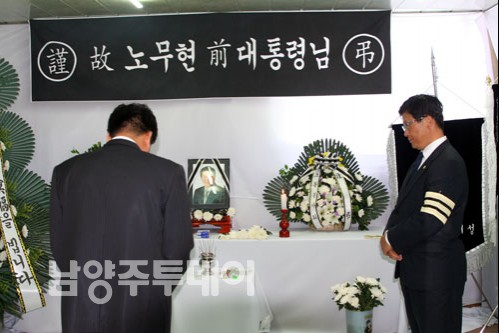
It is a sad time in South Korea because South Korea's former president, Roh Moo-hyun (노무현), has apparently committed suicide by jumping off a cliff behind his house. I also feel sad. Though I did not like him as a president, he was still a likeable man.

When a person dies in Korea, it is common to see the Chinese characters 謹弔 (근조) written on banners, flower arrangments, and envelopes in the mourning areas, as in the second picture below. The characters mean 삼가 조상하다, which means, "I respectfully offer my condolences." 謹 (근) means "삼가" (respectfully), and 弔 (조) means "조상하다" (offer one's condolences).

Since I do not know the family, I offer my condolences to the Koreans who visit this blog for the loss of their former president. Also, though I am not a practicing Christian, I was raised one, so I ask God to take his soul into heaven.

Link


Do you get the joke behind the words in these pictures?

I get the joke behind some of the words, but not all.


Thursday, May 14, 2009

Do you know any good Korean slang?

UPDATE: I have received an e-mail from a Dr. Byung-Joon Lim (임병준), who claims to be the original author of the list of slang expressions listed below. He said he complied the list with his students in a Business Korean (KREN 4001) class at the University of Georgia in 2001. He also said that I could continue to post the list as long as I identified the source. Well, I think that is a small price to pay for such a useful list, so here is the link to Dr. Lim's Web site, which, itself, looks quite interesting:

http://english60.com/

Thank you, Dr. Lim.
________________________________________

I plan on refining the list, so if you have suggestions for changing or adding to it, please let me know in the comments section. Please include the English equivalent for any slang you might suggest:

  1. 됐거든.Please don't say anything more. (Used to show that you are tired of hearing someone's excuses.)
  2. 낚였어.You got me. You had me going there.
  3. 낚았지?I got you, didn't I. I had you going, didn't I?
  4. 당근이지.
    You bet./ Absolutely.
  5. 썰렁하군.That's a lame joke.
  6. 분위기 망치게 (조지게) 하지마. / 초치지마.
    Don't spoil the mood.
  7. 너나 잘 해.None of your business. Mind your own business.
  8. 내성질 건드리지 마.
    Don't get on my nerves.
  9. 뒷북치지마.Thanks for the history lesson. Hindsight is 20/20.
  10. 잘났어 정말. / 너 잘났다.
    You are somethng else.
  11. 어제 필름이 끊겼어.
    I blacked out (from drinking) last night.
  12. 그 사람 그거 참 잘~ 됐다. / 쌤통이다.
    He deserves it. Serves him right.
  13. 그래 니 팔뚝 (또는 니 X) 굵다.Yes, you're the man!
  14. 죽을만큼 마셔보자.Let's drink ourselves into stupor.
  15. 니가 나한테 어떻게 그럴 수 있니?
    How could you do that to me?
  16. 놀구 있네~~ 삽질 하네~~
    Yeah. Right~
  17. 거기 물 좋다
    That place rocks! That place kicks!
  18. (문제의 답 등이) 너무쉽네/애걔(걔) 그게다야?
    That's it? /Is that all?
  19. 너도 내 입장이 되어봐
    Put yourself in my shoes.
  20. 저리 가. 꺼져!Take a hike.
  21. 너 정말 치사하다.
    You're so cheap.
  22. 음식 잘 먹었습니다.I've never eaten better.
  23. 이 짓이 지겨워 죽겠어.
    This sucks!
  24. 몇 시에 퇴근해요?What time do you call it a day?
  25. 야, 친구 좋다는 게 뭐야?Come on, what are friends for?
  26. 너무 감격해서 눈물이 난다.It was so touching, I almost cried.
  27. 미안해 할 것까지는 없어.There's nothing to be sorry about.
  28. 내게 고마워할 것까지는 없어.There's no need to thank me.
  29. 이보다 더 좋을 순 없다.It couldn't be better than this!
  30. 메롱Neh Neh Neh Boo Boo
  31. 섭섭(실망)하지않게 해드리겠습니다!You won't be disappointed!
  32. 나를 만만하게 보지마.Don't think I am that easy.
  33. 니가 하는 일이 다 그렇지 뭐.That's what you always do.
  34. 분위기 파악 좀 해라, 인간아.Consider your surroundings, you fool.
  35. 두고보자.
    Just wait! I'll get (또는 pay) you back.
  36. 가만히 있으면 중간이나 가지.
    You should've kept quiet
  37. 이번 한 번만 봐준다.I'm gonna let it slide only this time.
  38. 쟤는 어디가도 굶어죽진 않겠다.No matter where he goes, he'll do just fine.
  39. 너무많은걸 알려고하면 다쳐.Knowing too much will only hurt you.
  40. 제발 잘난 척 좀 그만해.Stop acting like you're something special.
  41. 네가 없으니 뭔가 허전한 기분이야.
    I feel like something is missing when you're not here.
  42. 장난이 좀 심하군.
    Your joking is going a little too far.
  43. 말장난 그만 합시다.
    Let's stop playing word games
  44. 내가 만만하게 보여?Do I look that easy?
  45. 다 엎어버리고 뛰쳐 나가고싶다.
    I just want to drop everything and run away.
  46. 여기 분위기 엄청 살벌하다. (삭막하다)The atmosphere here is very tense (hostile).
  47. 몸이 찌뿌둥하다
    I feel heavy.
  48. 오해 하지 마세요.Don't get me wrong.
  49. 몸이 날아갈 것 같애. /가뿐해.I feel light as a feather. I feel good.
  50. 기가막혀 말이 안나오네.It's so upset I'm speechless.
  51. 니 맘대로 하세요.Suit yourself.
  52. 괜히 나만 실없는사람 되었잖아.It just made me look irresponsible.
  53. 허리가 삐걱했어.I hurt my back.
  54. 허리를 다쳤어요.I threw out my back.
  55. 아직 옛날 실력 안 죽었어.I've still got it.
  56. 넌 이제 죽었어.You're dead meat!
  57. 너 들으라고 한 소리 아냐.Don't take it personally.
  58. 까꿍!Peekaboo!
  59. 알랑거리지마.Don't try to butter me up.
  60. 배째
    Sue me!
  61. 그게 어딘데?That's better than nothing
  62. 머리뚜껑이 열렸다.My head is about to split.
  63. 그녀는 이중 성격을 가졌어.She has a multiple personality (split personality)
  64. 어디론가 멀리 훌쩍 떠나고 싶다.I just want to go somewhere far away.
  65. (나에게) 너무 심한 것 아니예요?Don't you think you're being too harsh (on me)?
  66. 그렇게까지 할 필요는 없어.You don't have to do all that
  67. 나도 맘이 편하지는 않아.I don't feel good about it, either.
  68. 그다지 썩 내키지는 않는데.
    I don't really feel like doing it
  69. 생각보다 '별로'인데.
    It's not as good as I expected.
  70. 몸살에 걸려 온몸이 쑤신다.My whole body aches.
  71. 그 사람 똥배가 나왔어.
    He has a big belly.
  72. 넌 내 밥이야.
    You're mine now! I've got you just where I want you.
  73. 저 사람은 인간이 왜 저래?What's his problem? What's wrong with him?
  74. 바늘로 꼭꼭 찌르는 것 같다.It feels like a needle poking me
  75. 걔 원래 그런 애야.He's usually like that.
  76. 너 삐졌니?Are you mad at me? Are you pissed off?
  77. 이 싸가지 없는 녀석아 (싸가지 means 싹수.)You're a hopeless case.
  78. 그는 밥만 축낸다.Food is wasted on him.
  79. 그는 성격이 털털하고 시원시원하다.
    He has an easy-going and cool attitude.
  80. 있는 척 좀 하지 마.Stop acting (Don't act) like you are rich.
  81. 사람보면 아는척 좀 해봐라.Why are you acting like you don't know me?
  82. 쟨 정말 짜다! 어떻게 밥 한번 안사니?
    He's so cheap. How can he not buy lunch even once?
  83. 너 공주병이구나.You think you're special, don't you?
  84. 저 애는 내가 찍었어.That boy (girl) is mine. He (She) is on my list.
  85. 쟤는 날라리야.He's a player (with the girls).
  86. 그는 앞뒤가 꽉 막혔어.
    He is so stubborn.
  87. 내 입장이 정말 난처해.My position is very uncomfortable.
  88. 그 사람은 건방지게 굴어.He acts like he's something special.
  89. 쟤 손 좀 봐 줘야겠다.
    He needs a lesson.
  90. 잘난체 하는 걸 아니꼬와서 못 보겠군!
    I can't stand watching him acting like he is something special.
  91. 그녀는 마음을 잘 주지 않고 튕겨.She's playing hard to get.
  92. 그는 뒤로 호박씨 깐다.He does things behind people's backs
  93. 야~~. 신난다.Yeah! This is fun!
  94. 놔둬! 그냥 그러다가 말겠지 뭐.Leave him alone. He'll stop it eventually.
  95. 이 숙제 정말 짜증난다.This homework is very tedious.
  96. 그 사진 너무 야하다.That picture is too sexy.
  97. 너무 오바 하지마. (오바 is Konglish for "'over' exaggerate.")
    Stop exaggerating. Don't over do it.
  98. 쟤랑 걔랑 그렇고 그런 사이래.They are said to have a relationship.
  99. 걘 늘 요리조리 빠져나간단 말이야.He always gets away with stuff.
  100. 그냥 그렇다고 해, 뭘 자꾸 따져?Just say it. Don't argue.
  101. 넌 왜 맨 날 그 모양이니?Why are you always like that?
  102. 뭐 이런 놈이 다 있어~!What kind of person is this! / I can't believe this guy!
  103. 저 사람 변태 아니야?
    Is he a pervert or something?
  104. 보자보자 하니 해도 너무 한다.I've tried to be patient, but this is going too far.
  105. 애들은 싸우면서 크는 거야.Fighting is a part of growing up.
  106. 어휴~ 난 이제 죽었다.Man.. I'm dead now.
  107. 걔 생각하면 지금도 가슴이 아프다.When I think about him, it still hurts.
  108. 옷이 촌스럽다.
    Those clothes are out of style.
  109. 기본부터 돼 먹지 않았다.It was wrong from the beginning.
  110. 지나가던 개도 웃겠다.A passing dog would even laugh.
  111. 나 나이 헛 먹은 거 아냐!Do you think I was born yesterday?
  112. 누구 맘대로?With whose permission?
  113. 니가 잘나면 얼마나 잘났니?If you've special, how special could you be?
  114. 아! 사는 게 왜 이럴까.Why is my life like this?
  115. 그 여자는 너무 코가 높아 (콧대가 세다/도도하다).She's too snobby.
  116. 내 일은 내가 알아서 다 할거야.
    I'll take care of my own business.
  117. 뭐 찔리는 거라도 있는 거야?
    Do you feel guilty about something?
  118. 니 입만 입이냐?You're not going to share your food?
  119. 내 방은 지저분해서 발 디딜 틈이 없어.My room is so messy, there is no place to step.
  120. 좋은 게 좋은 거지.If it's nice, it's nice.
  121. 넌 꼭 그런 말만 골라 하는군.Why do you always say things like that?
  122. 찍어둔 사람 있습니까?Do you have someone in mind?
  123. 너 시치미 떼지마.Don't you try to lie. (you 에 강세)
  124. 그거 수상한 냄새가 나는데.There's something fishy about it.
  125. 느낌이 오는데. / 감이 잡히는데.I got a hunch.
  126. 그는 자신감으로 똘똘 뭉쳤다.He is full of self-confidence
  127. 좋은 사람 있으면 소개 시켜 줘.If you know someone good, hook me up.
  128. 팀웍이 중요하다. 혼자 너무 튀지 마라.Teamwork is important, so don't try to stick out.
  129. 난 쓸데없는 오해받기 싫어.I don't want to risk being misunderstood.
  130. 네가 보고 싶으면 어떻게 참지?What do I do if I start missing you?
  131. 우정이 갈수록 부실해진다.Friendship fades with time.
  132. 모든 게 귀찮아.Everything is a hassle.
  133. 누가 니 성격을 받아주겠니.Who would put up with your attitude?
  134. 감쪽같이 (사귀는 관계를) 속이다니.How could you hide your relationship from everyone!
  135. 결코 고의가 아니었다.
    I didn't mean to do that. / It's not what I mean.
  136. 넌 배신자다.You are a traitor!
  137. 다 티 난다.Everything shows./ It's too obvious. / You can't hide it.
  138. 과연 얼마나 버틸 수 있을까?How long could it last?
  139. 좀 봐 주면서해라. (불쌍하다)Be a little gentle with him.
  140. 너하곤 게임이 안 된다. (상대가 안 된다)You are no match for me.
  141. 그래서?내가 어떻게 하길 바라니?So? What do you want me to do?
  142. 이젠 돌이킬 수가 없다. (소용없다)There is no turning back now.
  143. 농담도 (장난도) 사람 봐가면서 해라.
    Don't take a joke too far.
  144. 네게 섭섭하다.I"m disappointed with you.
  145. 사랑이 식었구나
    The love is gone.
  146. 우리 사이가 애매하다..
    Our relationship is confusing.
  147. 이 엄살쟁이.
    You big baby.
  148. 너의 잘못을 남에게 떠넘기지 마.Don"t try to put your mistakes on others.
  149. 까불고 있어. 다음부터는 까불지마.Don't try joking anymore.
  150. 야! 너 인물이 훤해졌구나.Hey, your face looks a lot better.
  151. 도대체가 끝이 안 보이네, 끝이....I don't see the end of this.
  152. 귀가 멍멍하다. (비행기를 탔을때)My ears are muffled.
  153. 얌전한 남자아이.Calm and reserve boy. Sissy boy.
  154. 화장 잘 받았다!Your makeup looks good!
  155. 너, 화장 떳어!Your makeup doesn't look good!
  156. 내 말 안 듣더니, 그래 꼴 좋다.You didn't listen to me, so now look at you!
  157. 그렇게 함부로 말하면 안 돼.You shouldn't talk like that
  158. 전 간지럼을 잘 타요.I am ticklish.
  159. 마음이 붕 떠 있어서 일이 손에 안 잡혀.I'm so excited, I can't work.
  160. 행복한 고민 하시네요.You have pleasant worries.
  161. 잔머리 돌리지 마.Don't try to take the easy way out.
  162. 친구 지간에 그런 게 어딨니?How could you do that to a friend?
  163. 어휴! 넌 아무도 못 말린다니까~~~!
    You're hopeless. What am I going to do with you.
  164. 입에 침이나 바르고 거짓말해라.If you are going to lie, at least do a better job of it.
  165. 그 사람 참 분위기 있더라.He has a lot of charisma. / She has class.
  166. 그 놈은 화를 자초했군.He asked for it!
  167. 외유내강.A steel hand in a velvet glove.
  168. 무게 잡지마. (최민수 같이)Don't try to act tough.
  169. 내 모든 걸 걸었어.I put everything into it.
  170. 골라먹는 재미가 있다.It's fun picking out my favorite.
  171. 너에겐 내가 있잖아.But you've got me.
  172. 원샷!Bottoms up!
  173. 강심장이군.His heart is made of stone.
  174. 오늘은 내가 쏜다.Today, it's on me! I'll pay.
  175. 왜 너 찔리니?Why? You feel guilty?
  176. 여기서 지척에 살아.I live a stone's throw away from here.
  177. 그녀에게 뿅갔어.I got a crush on her!
  178. 왜 나한테 화풀이야?Why are you taking it out on me?
  179. 말이 청산유수로군.He's a good talker.
  180. 내숭 떨지마.Don't play innocent!
  181. 흔들리면 안돼.Don"t waffle.
  182. 남자는 여자하기 나름이야.The woman makes the man.
  183. 쪽 팔리는 줄 좀 알아라.Shame on you!
  184. 그래도 그만하길 다행이다.It could've been worse.
  185. 그는 골칫 덩어리야.He's a pain in the neck.
  186. 모든 일엔 다 때가 있다.There is a time for everything.
  187. 그걸 꼭 말로 해야되니?Do I really have to say it?
  188. 좀 책임감을 가져라.Try to be more responsible.
  189. 너 많이 컸다!You've come a long way!
  190. 기분 짱인데.I feel like a million dollars.
  191. 난 타고난 체질이야.I was born for this.
  192. 아까워라!What a waste!
  193. 음매 기죽어!That hurts! What a blow to the ego!
  194. 맞장구 좀 쳐 주라.Back me up here.
  195. 괴롭히지 좀 마세요!Hey, get out of my hair!
  196. 잠깐만 시간 좀 내주실 수 있으세요?Have you got a minute to spare?
  197. 너 제정신이니?Are you out of your mind?
  198. 너 뭔가 믿는 구석이 있구나.You've got "an ace in the hole" (a card up your sleeve), right?
  199. 이거 장난이 아닌데!Man, this isn't a joke!
  200. 간뎅이가 부었군.What a nerve!
  201. 벌써 김샜어.
    I've already lost interest.
  202. 돈은 문제가 아니에요.
    Money is no object.
  203. 그냥 몸만 와라.Just bring yourself!
  204. 나 거지 됐어!I'm flat broke!
  205. 말도 안 되는 소리야.
    It doesn't make any sense.
  206. 꿈 깨Get real! / Not in your life time!
  207. 얼굴이 많이 부었어요.Your face looks puffy.
  208. 아직도 다 하려면 멀었어.I have still got a long way to go.
  209. 내 곁에 있어줘.
    Keep me company.(Stay with me.)
  210. 점심때 뭐 먹었니?What did you have for lunch?
  211. 안타깝게도...
    Regretfully,...
  212. 밑져봐야 본전이다.It doesn't hurt to try. You've got nothing to lose!
  213. 내 맘대로 하도록 내버려 둬!Let me do it my way! Let me live my own life.
  214. 벼룩의 간을 내먹어라.
    You're trying to get blood from a stone.
  215. 거의 다 왔어.We are almost there.
  216. 날 물로 보지마.Who do you think you're talking to?
  217. 지킬 건 지켜야지.Let's be responsible!
  218. 쟤네들 닭살이야!
    Those guys are too lovey-dovely!
  219. 닭살 났어.I've got goose bumps.
  220. 닭살 커풀a lovey-dovey couple.
  221. 너무 심하군/엽기적이야
    That's gross! That's cultic!
  222. 우리 그냥 친구로 지내자.Let's just be friends.
  223. 그건 내가 할 소리야.Those are my words. That's what I was going to say.
  224. 너는 사진보다 실물이 더 예뻐.You look much better in person.
  225. 내 방문이 안에서 잠겼어.I'm locked out of my room.
  226. 하루 쉬겠습니다.I'm taking the day off.
  227. 내 맘대로 되는 게 또 있네.Another thing that's going my way.
  228. 집에 바래다줄게.I'll see you home.
  229. 내가 그걸 어찌 아니?How am I supposed to know?
  230. (야구장에서) 파도타기 하자
    Let's do the wave thing. (씽기: 아이들이 많이 씀)
  231. 좋은 기억만 간직할게.I'll always remember the good times.
  232. 물 흐리고 있네!You're ruining our image. (Stop dirtying our image.)
  233. 사랑은 움직이는 거야.Love is always on the move.
  234. 입장 바꿔 생각해봐.Put yourself in my shoes.
  235. 난 그렇게 씀씀이가 헤픈 여자가 아냐I don't waste money like that.
  236. 흥분하지마.Chill out! Just relax!
  237. 너 하나도 겁 안나!You don't scare me!
  238. 오리발 내밀지마.Don't try to get out of it. (빠져나갈 생각 마)
  239. 난 맥주병이에요.I swim like a rock.
  240. 나 그런 쪽으로 빠삭해 (잘 알아).I've been down that road before.
  241. 내가 모르는 뭔가 새로운 것 좀 알려주세요.Tell me something I don't know.
  242. 대체 그런 얘기를 어디서 들었니?
    Where did you hear such a thing?
  243. 그건 아무 것도 아냐 더 심한 것도 있는데.That‘s nothing. I know worse than that.
  244. 깜박 하고 잊었어요.It slipped my mind.
  245. 나를 바람 맞혔어요.She stood me up.
  246. 딱지맞았어.She turned me down.
  247. 너 맛이 갔구나.
    You look trashed! (너 꼭 쓰레기 같구나)
  248. 지금 가는 중이야. 곧 도착해.I'm on my way. I'll be there soon.
  249. 그냥 지나갑시다.Let's skip that topic. (콩글리쉬: 패스 패스)
  250. 따져보길 잘했어.
    I was right to be picky. (꼼꼼히 실리를 따지다)
  251. 너한테 딱 안성맞춤이네.
    It's perfect for you! / It's a perfect fit. (안성맞춤)
  252. 나 지금 저기압이야.
    I'm in a bad mood now!
  253. 마음이 탁 놓인다!It is such a weight off my shoulders!
  254. 입맛 맞추기 힘드네.
    It's hard to satisfy your taste buds.
  255. 음식을 가리는군.
    You're a picky eater.
  256. 지킬 수 있는 약속만 해라!
    Only make promises you can keep!
  257. 네 맨 얼굴을 보고싶어!I wanna see the real you! (정관사 the 필수)
  258. 그러면 그렇지I expected as much. / It never fails!
  259. 정말 재밌었어I had such enormous fun.
  260. 나는 노는 물이 달라!I'm into different things! We're not in the same league.
  261. 넌 그 바탕으로 사니?
    How can you walk around with a face like that?
  262. 감이 잡았어.I've got the picture.
  263. 넌 양이 그렇게 중요하니?Is quantity all that you think about?
  264. 라면이 불었습니다.The noodles are overcooked.
  265. 에이, 좋다 말았네!Oh, I almost had it!
  266. 야, 밥이나 먹겠냐?You can't be a bread winner if you act like that!
  267. 넌 물먹은 거야.You're stuck in second gear. You've been set back.
  268. 네 마음의 창이 되어줄께.I'll be the window to your heart.
  269. 넌 국물도 없어.Sorry, not today.
  270. 딴 여자들한테 한 눈 팔지마.Keep your eyes off other women!
  271. 민박 있어요?Do you have any cabins?
  272. 넌 양이 그렇게 중요하니?Is quantity all you think about?
  273. 사기가 하늘을 찌르는구나.
    You're so fired up!
  274. 너 통 크다.You're a big spender.
  275. 너 통 정말 작구나
    You're so cheap!
  276. 세상을 다 가져라.
    The world is at your door's step.
  277. 엎어지면 코 닿을 데야.It's just around the corner.
  278. 어머, 부끄러워.
    Oh, I'm so embarrassed.
  279. 아이고, 진짜 웃긴다.That's so stupid / ridiculous
  280. 아름다웠던 시절로 돌아가고 싶어.
    I want to go back to the good old days.
  281. 내 모든 걸 걸었어.I put everything into it.
  282. 나 여기 7 년 동안 단골이야.I've been a regular here for 7 years.
  283. 와우, 몸매 죽이는데!Wow! She's got some curves.
  284. 자알 빠졌다.
    Wow! She's got some curves.
  285. 반말하지마.
    Don't use that impolite tone with me.
  286. 미운 정 고운 정 다 들었다.I've got mixed feelings for her.
  287. 그의 인기는 시들지 않아.His popularity never goes down!
  288. 당당하게 살아라.
    Stand tall!
  289. 저 여자 끝내주는데!She's really something!
  290. 따라 올테면 따라와 봐라.
    Catch me if you can. (공원에서 슬로우 모션으로)
  291. 날씬한 게 좋죠!The thinner the better!
  292. 폼 잡지마!Get real!! Get a job! Get a life! (싸울 때 쓰는 말)
  293. 너 참 귀가 엷구나!
    You're so gullible!
  294. 너 좀 너무 심한 거 아냐?Don't you think you're over-reacting a little?
  295. 왜 사서 고생하니?
    Why go through all the troubles?
  296. 속이 울렁거린다.
    I'm feeling a little queasy.
  297. 너 돈독이 올랐구나!
    You are too money hungry.
  298. 잘 자. 내 꿈꿔.Sleep tight. Dream of me.
  299. 너무 지나치게 멋 부리지마!
    Don't overdress.
  300. 세상에 공짜가 어딨어?
    There's no such thing as a free lunch!
  301. 한 번만 봐주세요.Give me a break!. (Look at me once: 콩글리쉬)
  302. 등 떠밀려 할 수 없이 그렇게 됐어.
    I was dragged into doing it.
  303. 잠깐 숨 좀 돌리자!Let's take a breath! (우리말과 발상이 똑 같음)
  304. 뒷일은 내가 책임질게!Just do it, I'll smooth everything over.
  305. 너 얼굴 반쪽이 됐어.You look like you're about to drop.
  306. 너, 철 좀 들어라!Why don't you act your age?
  307. 너랑 안 어울려.That doesn't go well with you.
  308. 게임은 계속되어야 한다.The game must go on.
  309. 말꼬리 잡지마.Stop twisting my words around.
  310. 지퍼 열렸어요.Your fly is open.
  311. 남대문 열렸어요.Your fly is open.
  312. 넘겨 집지마.Don't jump to the conclusion.
  313. 뭘 그리 꼬치꼬치 따지니?You're so nitpicky.
  314. 왜 꼬치꼬치 캐물어?Why are you being so inquisitive?
  315. 너 얼굴 참 두껍다.You're so brash.
  316. 우린 천생연분이야.We're made for each other.
  317. 너 눈 너무 높아.You're way too picky.
  318. 왜 나한테 그래?
    Why are you accusing me?
  319. 헌팅하러 가자.Let's pick up some chicks (guys: 남자를 헌팅할 때).
  320. 비행기 태우지 마Stop trying to flatter me!
  321. 오리발 내밀지마.Don't try to get out of it.
  322. 나를 꼭 좀 도와줘야 해요.You've gotta help me out.
  323. 그냥 놓칠 수 없어요.I'll never let it go.
  324. 뭐라고 감사를 드려야 할지 모르겠습니다.
    I can't thank you enough.
  325. 그는 항상 한 발 늦어요.
    He is always running behind.
  326. 그 놈은 버릇없는 놈이야.He's really rude.
  327. 이거 정말 끝내준다.This is totally awesome. (쥑여주는군)
  328. 황당하군.It leaves me speechless. (기가 막히는군)
  329. 애기처럼 징징거리지 마.Stop whining like a baby. (짜증내다 to whin)
  330. 우리 정리 좀 합시다.
    Let's all get on the same page.
  331. 난 이 일에 재주가 있어.I got knack for this.
  332. 두고 보자.You'll get yours. You'll be sorry for this.
  333. 너도 만만치 않아.
    You're just as bad as me.
  334. 거봐, 내가 뭐라고 그랬어.
    See, what did I tell you?
  335. 농땡이 치지마!
    Don't goof off!
  336. 너 개기니?Are you goofing off?
  337. 똑바로 얘기해 주세요.Give it to me straight. (더함과 덜함 없이)
  338. 내게 그런 핑계 대지마.Don't give me any excuses.
  339. 마음에 여유가 있을 때 하겠어요.
    I'll do it when I'm ready.
  340. 걱정 마. 내가 있잖아.I've got your back. / I'll be behind you.
  341. 집들이 할거예요.I'm going to have a house warming party.
  342. 머리를 좀 써봐.Use your head.
  343. 정말 놀랐어요.You nearly gave me a heart attack. (과장법)
  344. 좀 비켜 주세요!Please make way! (짐이요, 생선이요!)
  345. 왜 사니?What's on your mind?
  346. 정신을 어디다 두고 사니?What's on your mind?
  347. 음악 좀 크게 들읍시다!Crank up the tunes!
  348. 엄살 좀 피우지 마.Stop exaggerating. It didn't hurt that much.
  349. 넌 대책이 없어.
    You are helpless. (콩글리쉬: You have no big book)
  350. 니가 먼저 시작했잖아!
    You started it!
  351. 니 팔뚝 니 흔들고, 내 팔뚝 내 흔들자.
    You go your way, I'll go mine.
  352. 너 때문에 피곤해 죽겠어.I'm drained because of you.
  353. 이번에는 정말 잘 됐으면 좋겠어.I really want it to happen this time.
  354. 당신의 18번이 뭡니까?Which song can you sing the best?
  355. 난 누구한테든 갈 수 있어!I could be with anyone!
  356. 날 소유하려 하지마.Don't try to own me.
  357. 면목 없습니다.Sorry, I have no excuse.
  358. 너 이빨사이에 뭔가가 끼었어.You've got something between your teeth.
  359. 너무 기뻐 죽겠어요.I'm so happy, I could die.
  360. 가위 눌렸다.I had one of those nightmares where you can't move.
  361. 난 정신없이 바빴어.I've been busy as a bee!
  362. 눈 코 뜰 새 없이 바빴어.I've been busy as a bee!
  363. 나 회사에서 짤렸다.I got canned.
  364. 물 먹었다.I was fired.
  365. 눈썰미가 있구나.You pick things up quickly.
  366. 당신과 연락하려면 어떡해하죠?How can I get a hold of you?
  367. 글쎄? 도통 모르겠어I haven't the slightest idea. (“왜 전화 했어?“란 질문에)
  368. 그냥....Just because....... (그냥 전화 했어. 그냥 왔어)
  369. 이름 값 좀 해라.Live up to your name.
  370. 가위, 바위, 보.Paper, rock, scissors.
  371. 어리광 부리지 마.Don't play the baby.
  372. 기말 시험을 망쳤어.I bombed my final exam.
  373. 그녀는 정말 여우야.She is as sly as a fox.
  374. 김밥 옆구리 터지는 소리 하고있네!That's just ridiculous!
  375. 가끔은 별 일이 없을 때가 좋습니다.
    Sometimes no news is good news.
  376. 사각거리는 시원한 사과 먹었으면 좋겠다.
    I'd love to eat a refreshing crunchy apple.
  377. 너 그거 진짜 할거야?Are you really going to do it?
  378. 그거 할거야, 말거야?Are you gonna do it or not?
  379. 관계를 더욱 돈독히 해야합니다.We've got to cement our relationship.
  380. 벌써 다 끝내다니!You can't be done already!
  381. 왕입니다요
    You're the man.
  382. 건방지게 행동하지마.
    Don't be so arrogant.
  383. 국물이 끝내줘요.Good to the last drop. (맥스웰 커피 광고 카피)
  384. 상사병에 걸렸어요.The love bug has bitten me.
  385. 속이 거북하다.My gut is killing me. / My stomach is funny.(약한 통증)
  386. 그는 진짜 부자다.He is rich with a capital R.
  387. 자판기가 돈을 먹어버렸어요.The vending machine ate my money.
  388. 백지장도 맞들면 낫다.Two heads are better than one.
  389. 내게 행운을 빌어 줘.Wish me luck.
  390. 왜 안가고 서성대고 있어?Why are you lingering around?
  391. 버스 떠난 뒤에 손 흔들어 봤자야.That ship has already sailed.
  392. 다리 떨지마. 복 나가.It's unlucky to shake your foot.
  393. 그저 이런 저런 잡담이나 하고 싶어.
    I just wanna shoot the breeze.
  394. 어떻게 될지 누가 알겠니?No one can say how it'll turn out.
  395. 일찍 와도 안 잡아먹어.It wouldn't hurt to come early.
  396. 숨이 차 죽겠어.
    I'm out of breath.
  397. 그 사람 가까이 가지마.Stay clear of that guy. / Stay away from him.
  398. 제발 나를 괴롭히지 마.Hey, just lay off me.
  399. 내 컴퓨터가 다운되었어.My system crashed.
  400. 너 지금 까불고 있는 거니?Are you being a wise guy?
  401. 너 완전히 오해했구나!You really missed the point!
  402. 마음 한 구석이 좀 불편하다.It doesn't settle well with me.
  403. 이제 속이 시원하다.It doesn't get on my nerves anymore. I feel much better!
  404. 그 사람은 너무 튀어.That guy is a real odd ball.
  405. 나름대로는 열심히 했어.I think I did my best./ I did the best I could.
  406. 한 입으로 두 말 하지 마세요.Don't go back on your word.
  407. 사람을 외모만 보고 판단하지 마라.Don't judge a book by its cover.
  408. 늦었다고 생각할 때가 가장 빠를 때다.Better late than never.
  409. 난 추위를 잘 타요.The cold really gets to me.
  410. 이 책은 내용이 정말 알차다.
    This book's got it all.
  411. 야, 네가 못하는 게 뭐니?You can do anything you set your mind to.
  412. 우왕! 진짜 짜증나.Man, I'm so ticked. (tick은 모기처럼 무는 벌레)
  413. 네가 보고싶어 죽겠어.I'm dying to see you!
  414. 일을 하려면 제대로 해!If you're going to do, do it right!
  415. 야, 대체 비결이(요령이) 뭐야?Hey, what's the secret?
  416. 넌 빠져.Don't get nosy (코를 들이밀지 마 = 간섭 마)
  417. 가문에 먹칠하다.Give someone's family a bad name.
  418. 혈통 문제로군.It runs in the family.
  419. 나이 값을 좀 해라.Act your age!
  420. 엎어지면 코 닿을 데야.It's just around the corner.
  421. 어머, 부끄러워.I'm so embarrassed.
  422. 세상에 공짜가 어딨어?There's no such thing as a free lunch!
  423. 잠깐 숨 좀 돌리자!
    Let's take a breather.
  424. 뭐라고 감사를 드려야 할지 모르겠습니다.I can't thank you enough.

Saturday, April 25, 2009

Is there anything better than the "small comforts" in life?

Is there anything better than the "small comforts" in life?

Yes, of course, the large comforts.

The Chinese character 便 (편) means "편하다," which means "comfortable" or "easy." The character can also be pronounced as "변," but then the meaning changes to "urine" or "feces."

Is it just a coincidence that the literal meanings of 소변 (小便 - urine) and 대변 (feces) are "small comfort" and "large comfort"?

The pure Korean for urine and feces are 오줌 and 똥, respectively, but 소변 and 대변 sound more refined, for some reason.

By the way, if you want to tell a friend that you "want to take a piss" or " want to take a dump," it would be better NOT to say 오줌(소변)을 싸고 싶다 or 똥(대변)을 싸고 싶다 since that would imply that you want to piss in your pants or take a dump in your pants. Even many Koreans mistakenly say 오줌(똥) 싸고 싶다. Instead, you should say 오줌 (소변)을 누고 싶다 and 똥(대변)을 누고 싶다. Also, instead of 누다, you can use the verb 보다.

What's the difference between 굶다 and 주리다?

굶다 seems to mean "to go hungry," while 주리다 seems to mean "to be hungry." In other words, 굶다 seems to be the more serious situation since one does not have or cannot afford the food to eat. Therefore, if you wanted to say that someone "died from hunger," you would say, 굶어죽었다, not 주려죽었다.

Also, 주리다, not 굶다, is used in the figurative sense. See the following examples:
  • 사랑에 주리다 - be hungry for affection
  • 지식에 주리다 - be hungry for knowledge
굶다 and 주리다 also combine to form the word 굶주리다, which seems to have the implied meanings of both words. For example, 굶주리다 can mean literally "starving" or it can mean "hungry" in the figurative sense. See the following examples:
  • 가뭄 때문에 많은 사람이 굶주렸다.
    Many people starved during the drought.
    .
  • 그는 지식에 굶주리고 있었다.
    He was hungry for knowledge.
    .
  • 병사들은 피에 굶주리고 있었다.
    The soldiers were thirty for blood.
I like the simplicity of the following proverb:
주린 고양이가 쥐를 만났다.
A hungry cat met a mouse.
It means, "It looks like this is my lucky day."

Saturday, March 28, 2009

Hear about Naver's New Chinese Character Dictionary?

Naver has updated its online Chinese Character Dictionary, and it is good. Not only does the dictionary have a new look and new functions, but the number of characters in the dictionary has increased from 7700 to 28,000. Here are the new functions:
  • Drawing Recognition (필기인식기): This allows you to search for a character by drawing it with your mouse.
    .
  • Shape Search (모양자 찾기): This allows you to search by only knowing one portion of the character. For example, if you search on 乙, it will show you all the characters with 乙 in them, regardless of whether 乙 is the radical for that character or not. This function is great and long overdue.
    .
  • Auto Completion (자동완설기능): This offers suggestions even before you press the "Enter" key.

I love this new dictionary.

Saturday, March 21, 2009

What are Korea's Irregular Verbs?

The following is the start of a list of Korean irregular verbs and their conjugations. I will build the list and add to it when I have the time.

  • 가늘다 [adj] - 1) small; thin, slender; 2) narrow 3) weak; feeble; faint

    An irregular ㄹ verb

    가늡니다 / 가늘었습니다 / 가늘고 / 가는 / 가는데 / 가느니까 / 가늘더니 / 가늘면 / 가늘어서 / 가늘어야 / 가늘어요
    .
  • 가르다 [v] - 1) cut ; divide 2) separate; sort out; classify 3) share with; divide among 4) cut off; sever; separate

    An irregular 르 verb

    가릅니다 / 갈랐습니다 / 가르고 / 가르는 / 가르는데 / 가르니까 / 가르더니 / 가르면 / 갈라서 / 갈라야 / 갈라요 / 가르십시오
    .
  • 가볍다 [adj] - 1) light ; not heavy 2) light ; slight 3) rash; thoughtless; frivolous

    An irregular ㅂ verb

    가볍습니다 / 가벼웠습니다 / 가볍고 / 가벼운 / 가벼운데 / 가벼우니까 / 가볍더니 / 가벼우면 / 가벼워서 / 가벼워야 / 가벼워요
    .
  • 1 거르다 [v] - 1) filter; strain (out); percolate; leach 2) select; choose; pick out
    .
    2 거르다 [v] - skip (over); go without; dispense with

    An irregular 르 verb

    거릅니다 / 걸렀습니다 / 거르고 / 거르는 / 거르는데 / 거르니까 / 거르더니 / 거르면 / 걸러서 / 걸러야 / 걸러요 / 거르십시오
    .
  • 걷다 [v] - walk; go on foot; tramp; step; hike

    An irregular ㄷ verb

    걷습니다 / 걸었습니다 / 걷고 / 걷는 / 걷는데 / 걸으니까 / 걷더니 / 걸으면 / 걸어서 / 걸어야 / 걸어요 / 걸으십시오
    .
  • 1 고르다 [v] - choose; select

    2 고르다 [v] - level ; smooth; make even

    3 고르다 [adj] - 1) even; uniform; equal; regular 2) equal; fair; impartial 3) seasonable; favorable

    An irregular 르 verb

    고릅니다 / 골랐습니다 / 고르고 / 고르는 (v); 고른 (adj) / 고르는데 (v); 고른데 (adj) / 고르니까 / 고르더니 / 고르면 / 골라서 / 골라야 / 골라요 / 고르십시오 (v)
    .
  • 고맙다 [adj] - 1) grateful; welcome; blessed; appreciated; gracious 2) thankful; appreciative; gratefully acknowledged; obliged; indebted

    An irregular ㅂ verb

    고맙습니다 / 고마웠습니다 / 고맙고 / 고마운 / 고마운데 / 고마우니까 / 고맙더니 / 고마우면 / 고마워서 / 고마워요
    .
  • 고프다 [adj] - hungry; famished

    An irregular 으 verb

    고픕니다 / 고팠습니다 / 고프고 / 고픈 / 고픈데 / 고프니까 / 고프더니 / 고프면 / 고파서 / 고파야 / 고파요
    .
  • 곱다 [adj] - 1) beautiful; lovely; fine; nice; handsome 2) sweet ; gentle; pure-minded 3) sweet ; charming; soft 4) fair ; fine

    An irregular ㅂ verb

    곱습니다 / 고왔습니다 / 곱고 / 고운 / 고우데 / 고우니까 / 곱더니 / 고우면 / 고와서 / 고와야 / 고와요
    .
  • 굽다 [v] - 1) roast; broil; bake; toast 2) bake (pottery); fire; burn ; produce

    An irregular ㅂ verb

    굽습니다 / 구웠습니다 / 굽고 / 구운 / 굽는데 / 구우니까 / 굽더니 / 구우면 / 구워서 / 구워야 / 구워요 / 구우십시오
    .
  • 그렇다 [adj] - so; such; like that; that way; Yes, No

    An irregular ㅎ verb

    그렇습니다 / 그랬습니다 / 그렇고 / 그런 / 그런데 / 그러니까 / 그러더니 / 그러면 / 그래서 / 그래야 / 그래요 / 그러십시오*

    * 그렇다 is an adjective, so it should not have an imperative form. Therefore, 그러십시오 probably comes from 그러다, which is an abbreviation of 그렇게 하다.

Wednesday, January 14, 2009

Am I wasting my life away?

The following is a poem I wrote about a woman's decision to leave her husband, which she later regrets. I wrote the poem because the first two lines came into my head and I couldn't get them out of it. It has nothing to do with Korean.

Brief Infatuations

Do you sometimes fake orgasm?
Do you sometimes use sarcasm?
Do you sometimes come home late
And deny it was a date?

Do you sometimes look at him
And wish he were more like them?
Do you sometimes go to bed
And imagine he were dead?

Now you want to let him know
That it’s time for you to go.
Yes, he will most likely cry,
And ask you to tell him why.

Say you’re bored and want to live
While you’ve still got love to give
He won't know that you have lied,
And had others on the side.

Years later you’re still alone.
He found new love and a home.
Now you’re sitting wonder’n why
You ever left him for that guy.

Is life now trying to say
It's your fault you ran away?
Have you already missed your chance
In this world to find romance.

by Gerry Bevers

Saturday, December 20, 2008

Is this the way to Amarillo?

I was feeling a little homesick, so I decided to learn the Korean lyrics for the following song, but I couldn't find them, so I decided to make my own. Do not expect a word-for-word translation.


"Is this the way to Amarillo"

When the day is dawning,
On a Texas Sunday Morning

일요일 아침에
텍사스 하늘이 밝아질 때

How I long to be there
with Marie who's wait'n for me there

거기 있고 싶어요
날 기다리는 여자랑

Every lonely city
where I hang my hat

쓸쓸한 도시에
많이 갔는데도

Ain’t as half as pretty
as where my baby’s at.

내 여자 도시는
훨씬 더 예뻐요.

Is this the way to Amarillo
Every night I’ve been hugging my pillow
Dreaming dreams of Amarillo
And sweet Marie who waits for me

앰마렐로 이 쪽인가요?
밤마다 베게 꼭 껴안아요
꿈에서 나타나요
그 도시와 내 여자요.

Show me the way to Amarillo
I’ve been weeping like a willow
Crying over Amarillo
And sweet Marie who waits for me

앰마렐로 길을 보여줘요.
버들처럼 계속 울어요.
생각나면 꼭 울어요.
그 도시와 내 여자요.

Sha la la la la la la la
And Marie who waits for me.

샤라라라라라라라
샤라라라라라라라
샤라라라라라라라
기다리는 내 여자요.

There’s a church bell ringing
hear the song of joy that it’s singing
For the sweet Maria
and the guy who’s coming to see her

성당 종이 우네요
그 행복한 소리 들어요.
내 작한 여자와
보러 가는 나를 위하여.

Just beyond the highway
There’s an open plain
and it keeps me going
Through the wind and rain

앞길 조금 넘어
평야 있는데
계속 가겠어요
폭풍 있어도요.

Is this the way to Amarillo
Every night I’ve been hugging my pillow
Dreaming dreams of Amarillo
And sweet Marie who waits for me

앰마렐로 이 쪽인가요?
밤마다 베게 꼭 껴안아요
꿈에서 나타나요
그 도시와 내 여자요

Show me the way to Amarillo
I’ve been weeping like a willow
Crying over Amarillo
And sweet Marie who waits for me

앰마렐로 길을 보여줘요.
버들처럼 계속 울어요.
생각나면 꼭 울어요.
그 도시와 내 여자요.

Sha la la la la la la la
And Marie who waits for me.

샤라라라라라라라
샤라라라라라라라
샤라라라라라라라
기다리는 내 여자요.

Sha la la la la la la la
And Marie who waits for me.

샤라라라라라라라
샤라라라라라라라
샤라라라라라라라
기다리는 내 여자요.

Here are links to a few more versions:

Sunday, November 02, 2008

Why do they call it 단청(丹靑)?


The above picture shows the colorfully painted eaves of a traditional Korean building. Koreans call this type of decoration 단청(丹靑), which literally means "red & blue." 단 means "red," and 청 means "blue." The name comes from the fact that red (which includes orange) and blue (which includes green) are the representative colors used in the painting.

By the way, 단 (丹) is not the only Chinese character that means "red." There are, at least, four others that represent different shades of red. Also, there are, at least, five Chinese characters for blue. Here is a list of the characters that mean "red," starting with the lightest red and progressing to the darkest.

Shades of Red in Chinese Characters

  1. 홍(紅) - pinkish red
  2. 적(赤) - red
  3. 단(丹) - red
  4. 주(朱) - vermilion; cinnabar
  5. 강(絳) - crimson

Shades of Blue (green) in Chinese Characters

  1. 청(靑) - dark blue
  2. 창(蒼) - azure (sky blue)
  3. 벽(碧) - greenish blue
  4. 록(綠) - (grassy) green
  5. 취(翠) - jade green

The Five Cardinal Colors in Korea (오색)

  • 청(靑) - blue
  • 적(赤) - red
  • 황(黃) - yellow
  • 백(백) - white
  • 흑(黑) - black

Colors of the Rainbow

  • red - 빨강색
  • orange - 주황색
  • yellow - 노랑색
  • green - 초록색
  • blue - 파랑색
  • indigo - 남색
  • violet - 보라색

Names of Colors (unfinished) *

  • amber (pumpkin) - 호박색
  • amethyst - 자수정빛
  • apricot - 살구빛
  • aqua (greenish blue) - 녹청색 (more green than blue)
  • aquamarine (light aqua) - 연한 녹청색
  • auburn (redish brown) - 고동색 (적갈색)
  • azure (sky blue) - 하늘색
  • baby blue - 연한 청색
  • black - 흑색; 검은 색
  • blue - 푸른색; 파랑; 청색
  • blue-green (turquoise) - 청녹색 (more blue than green)
  • brass (yellowish copper) - 황동색
  • bronze - (bluish copper) - 청동색
  • brown - 갈색
  • Burgundy - 버건디색; 짙은 홍색
  • cardinal red - 진홍색
  • celadon - 청자색
  • chestnut (maroon) - 밤색; 적갈색
  • cinnabar - 주홍색
  • cinnamon - 육계색
  • copper - 동색; 구릿빛
  • cream - 크림색
  • crimson (ruby red) - 심홍색
  • cyan - 시안색
  • dark (deep) blue - 검푸르다; 암청색 (심청색)
  • dark (deep) green - 암녹색 (심녹색)
  • dark (deep) red - 검붉다; 암홍색; (심홍색)
  • dark yellow - 검누렇다
  • eggplant - 가지색
  • emerald - 선녹색
  • flax - 아마색
  • flesh color - 피부색; 살빛
  • gold - 금색; 황금색
  • green - 녹색
  • grey - 회색
  • indigo (deep blue) - 남색
  • ivory - 상아색 (아이보리)
  • jade - 옥색
  • khaki - 카키색 (황갈색)
  • lavender - 라벤더색
  • maroon (chestnut) - 밤색; 적갈색
  • mauve - 담자색
  • moss green - 이끼 녹색
  • mustard - 겨자색
  • navy blue - 감청색
  • olive - 올리브색
  • orange - 주황색; 오렌지색
  • orchid - 연보랏빛; 난초색
  • peach - 복숭앗빛
  • pink - 분홍색
  • platinum - 백금색
  • pumpkin (amber) - 호박색
  • purple - 자주빛
  • rose - 장밋빛
  • ruby red (crimson) - 심홍색; 홍옥색
  • salmon - 연어 살빛
  • sapphire - 청옥색; 사파이어색
  • saffron - 사프란색 (농황색)
  • silver - 은색; 은빛
  • sky blue - 하늘색
  • turquoise (blue-green) - 청녹색; 터키옥색
  • violet - 보라빛; 제비꽃색
  • white - 하얀색
  • yellow - 노란색; 황색

Saturday, October 25, 2008

What is the opposite of 태양(太陽)?

태양(太陽) is the sino-Korean word for "the sun." It literally means "big star." 태(太) means "big," and 양(陽) means "star. 양(陽) can also mean "bright." The pure Korean word for "the sun" is 해.

The opposite of 태양(太陽) is 태음(太陰), which is a sino-Korean word for "the moon." It literally means "big shadow." 태(太) means "big," and 음(陰) means "shade" or "shadow." The pure Korean word for "the moon" is 달.

The Chinese characters 양(陽 - light) and 음(陰 - dark) form the word 음양(陰陽), which refers to the philosophy that everything in the universe has an opposite. The Chinese call it "yin-yang."

Here are more words that use the Chinese characters 음(陰) and 양(陽):
  1. 양력(陽曆) - solar calendar
    음력(陰曆) - lunar calendar
    .
  2. 양지(陽地) - a sunny place
    음지(陰地) - a shady place
    .
  3. 양성(陽性) - positive
    음성(陰性) - negative
    .
  4. 양수(陽數) - a positive number
    음수(陰數) - a negative number
    .
  5. 양극(陽極) - a positive pole (electricity)
    음극(陰極) - a negative pole (electricity)
    .
  6. 양각(陽刻)하다- emboss (carve in relief)
    음각(陰刻)하다 - engrave

If anyone can think of more words, I will add them to the list.

Friday, October 03, 2008

"독도," by Gerry Bevers

독도는 우리 땅
문서, 지도 없어도
무조건 우리 땅.

삼국사기에 의해
우산국 있었는데
울릉도이었지만
그냥 독도라면 돼.

독도는 우리 땅
문서, 지도 없어도
무조건 우리 땅.

세종기록에 의해
울진현의 동쪽에
우산울릉 안 멀어
좋은 날에 보인대.

방향, 거리 있어야
위치 알 수 있는데
방향 없는 거린데
그냥 독도라면 돼.

독도는 우리 땅
문서, 지도 없어도
무조건 우리 땅.

우리 고도에 의해
우산도 있었는데
울릉 서쪽 있어도
그냥 독도라면 돼.

독도는 우리 땅
문서, 지도 없어도
무조건 우리 땅.

성종기록에 의해
삼봉도 있었는데
울릉도를 무시해
그냥 독도라면 돼.

독도는 우리 땅
문서, 지도 없어도
무조건 우리 땅.

숙종기록에 의해
안용복 있었는데
울릉도에 갔을때
일본 손님 됐는데

안용복의 주장는
송도가 자산도다
어딘지는 몰라도
그냥 독도라면 돼.

독도는 우리 땅
문서, 지도 없어도
무조건 우리 땅.

천칠백십일년에
삼척영장 박석창
울릉 지리 다 보고
지도를 그렸는데

울릉도의 동쪽에
우산도를 썼는데
대나무밭 있어도
그냥 독도라면 돼.

독도는 우리 땅
문서, 지도 없어도
무조건 우리 땅.

정조때 한창국이
울릉도에 나가고
가지도의 강치는
두 마리를 잡았대.

가지도 앞 계곡은
십리 깊이 있는데
그런 계곡 없어도
그냥 독도라면 돼.

독도는 우리 땅
문서, 지도 없어도
무조건 우리 땅.

우리 많은 고도에
울릉 바로 동쪽에
둘 아닌 한 섬으로
우산도를 그렸네.

울릉도의 동쪽에
작은 죽도 있는데
그 사실을 무시해
그냥 독도라면 돼.

독도는 우리 땅
문서, 지도 없어도
무조건 우리 땅.

천구백년에 고종은
울릉, 죽도, 석도를
모두 합해가지고
한 군으로 지셨네.

죽도, 관음 외에도
많은 석도 있는데
그 사실을 무시해
그냥 독도라면 돼.

독도는 우리 땅
문서, 지도 없어도
무조건 우리 땅.

by Gerry Bevers