The Korean word for "pituitary gland" is 뇌하수체 (腦下垂體), which literally means "brain (腦) below (下) hanging (垂) body (體)." The name refers to the location of the pituitary gland in the skull.
Personally, I think a better name for the pituitary gland would be 뇌하수고 (腦下垂睾), which would translate as "testicles that hang below the brain."
In Korean, a paramecium is called 짚신벌레, which literally means "straw (짚) shoe (신) bug (벌레)" or "straw sandal bug," because it is shaped like a traditional Korean sandal made from rice or barley straw, with one rounded end for the heel of the sandal and a more slightly pointed end for the toe.
Dong-A's Prime Korean-English Dictionary defines 각색 as "dramatization," "stage version," and "cinematization," but 각색 (脚色) literally means "leg (脚) color (色)," so how did "leg color" come to mean "dramatization"? I can only guess.
각광 (脚光) literally means "leg (脚) lights (光)" but is defined as "footlights," which are lights placed at the front of a stage to illuminate actors from foot level. Footlights allow the audience to see the actors without any obstruction, and the "color" of the lights can also effect the mood of a scene.
So my guess is that 각색 (leg color) is related to 각광 (leg lights), which implies a stage performance. In other words, if you are going to make a novel into a play (dramatize a novel), you will need a stage and footlights to highlight the actors, so maybe that is how "lighting" or "coloring" legs came to mean "dramatization"?
I have read that the modern meaning of 각색 has something to do with corrupt officials in ancient China, but I don't buy that explanation.
Dong-A's Prime Korean-English Dictionary defines 다반사 (茶飯事) as "a matter of no importance," but it literally means "a tea (茶) [and] rice (飯) matter (事)," and tea and rice are things Asians drink or eat everyday. In other words, seeing people in Asia drinking tea and eating rice is a common sight and nothing to get excited about.
Dong-A's Korean-English Dictionary defines 호떡 as "a Chinese stuffed pancake," which may sound somewhat gruesome, but what it means is "a Chinese-style stuffed pancake." The reason they define it as a "Chinese" pancake is because it originally came from China.
The 떡 in 호떡 means "rice cake," and the 호 (胡) means "barbarian," "savage," or "foreigner." Koreans used to consider anyone who was not Korean to be a "barbarian," including the Chinese, it appears.
So, 호떡 literally means "barbarian (호) rice cake (떡)."
Some Koreans, however, mistakenly think the 호 is 호떡 comes from 호하다, which means "to blow." Why? Because you often have to blow on a hot Chinese pancake to cool it off enough to eat it.
In 1977, I first arrived in Korea in the U.S.navy and stayed there until the fall of 1979. In 1978, a song sung by Korean singer Kim Man-jun (김만준) became a hit. The song's name was 모모.
At the time, I understood 모모 to be the name of a young girl from a novel entitled "Momo," written by Michael Ende, but now I wonder if the 모모 in the Kim Man-jun song was also meant to mean "some people," which in Korean can also translate as 모모 (某某).
Using 모모 to mean "some people," here is my translation of the lyrics of the Kim Man-jun song 모모.
모모는 철부지, 모모는 무지개 Some people are childlike, some people are rainbows.
모모는 생을 쫓아가는 시계바늘이다. Some people are the hands of a clock pursuing life.
모모는 방랑자, 모모는 외로운 그림자 Some people are wanderers, some people are lonely shadows,
너무 기뻐서 박수를 치듯이 날개짓하며 Flapping their wings as if they are clapping for being so happy.
날아가는 니스의 새들을 꿈꾸는 모모는 환상가 Some people are dreamers, dreaming of the flying birds of Nice (French city?)
그런데 왜 모모 앞에 있는 생은 행복한가? But why are the future lives of some people happy?
인간은 사랑 없이 살 수 없다는 것을 Human beings cannot live without love, it is said,
모모는 잘 알 고 있기 때문이다. So it is because some people know this.
ANSWER: It is a social media Web site where I am also posting about the Korean language. You can click HERE if you would like to check out my posts there.
The Korean word 십상 means "just right" or "perfect," according to Dong-A's Prime Korean-English dictionary. But 십상 comes from 십성 (十成), which literally means "a ten (十) achievement (成)." On a scale of one-to-ten, a "ten achievement" would be "a perfect score" or "the highest ranking."
Over time 십성 came to be pronounced 십상.
So, the Korean sentence 하이킹 날씨로는 십상이다 can be translated as "This is the perfect (십상이다) weather for hiking (하이킹 날씨로는)."
십성 (十成) was used to refer to the purity of such metals as "gold" (금 金) and "silver" (은 銀), so 십성금 (十成金) could be translated as "pure gold" and 십성은 (十成銀) as "pure silver."
Since ten-out-of-ten was the highest ranking, one-out-of-ten would be the lowest ranking, so since 일 (一) is the Sino-Korean word for "one," the lowest quality of gold and silver would be 일성금 (一成金) and 일성은 (一成銀), respectively.
ANSWER: No. It means "people" (사람) who live in a "seaside village" (갯마을) on the "shore of an estuary or inlet" (갯가), where one will often find "tidal mudflats" (갯벌 or 개펄), which are sometimes called 갯뻘 or 개뻘.
Here the word 개 does not mean "dog." It is a pure Korean word that means "inlet," "cove," or "estuary." And 벌 or 펄 means "field," so 갯벌 and 개펄 literally mean "estuary/inlet (개/갯) field (벌/펄)," where you will find 개흙, "the slimy mud or silt on the bank of an inlet or estuary."
By the way, 갯바람 translates as "sea breeze" but literally means "estuary/inlet (갯) wind (바람)."
From Dong-A's Prime Korean-English Dictionary (1998)
Do you like "house profits separated" on you pancakes?
The transliteration of the word "syrup" (시럽), using Chinese characters, is 사리별 (舍利別), which literally means "house (舍) profits (利) separated (別)." In other words, the Chinese characters are used for their sounds, not their meanings.
There is also the word 단사리별 (單舍利別), which literally means "single (單) house (舍) profits (利) separated (別)," but I think the 단 (單) is a transliteration of the Korean adjective 단, which is a form of 달다 and means "sweet." So, 단사리별 would mean "sweet syrup," not "simple syrup," as Naver's Korean-English dictionary translates it.
It is not in my Korean-English dictionary, but the supposedly pure-Korean word 망정 in 망정이지 means "lucky" or "fortunate," but why does it mean "lucky" or "fortunate"? What is the origin of the word? I cannot find anything on its etymology.
The word 망정 does appear in my Korean-Korean dictionary with the following definition:
"[대개, '-니 망정이지' 또는 '-기에 망정이지'의 꼴로 쓰이어] '-니(기에) 다행이지'의 뜻을 나타내는 말."
"[Usually used in the form of '-니 망정이지' or '-기에 망정이지'], the word appears to mean 'to be fortunate/lucky with something' (니/기에 다행이지)."
So, instead of saying 망정이지, one could say 다행이지 (lucky/fortunate).
There is also an example sentence with the definition:
"미리 알았기에 망정이지 큰일날 뻔했다"
"It's lucky we knew in advance; we almost had a big problem."
Though my Korean-Korean dictionary does not say anything about the etymology of the "lucky/fortunate" 망정, it does list another 망정 (望定) just below it that is defined as follows:
"조선때 관원을 천거(薦擧)할 때 후보자로 세 사람을 지명하던 일"
"The act of nominating three candidates for a government post during the time of Joseon."
Could the "lucky/fortunate" pure-Korean 망정 be related to the "nominating three candidates for a government post" Sino-Korean 망정 (望定)?
I wonder because the Chinese characters in the Sino-Korean word 망정 (望定) literally mean "a wish or hope (望) is decided (定)," which would be "lucky" or "fortunate" for the person whose "wish or hope was decided (망정)." It could also be translated as "a hopeful or desired decision."
젬병 is Korean slang for "being terrible at" (형편없다) doing something. Here is an example sentence:
내가 과학에는 젬병이다
"I'm terrible at Science."
But 젬병 comes from 전병 (煎餠), which my Korean-English dictionary defines as Korean-style "pancakes." So that means the above Korean sentence can literally translate as follows: "I'm a pancake at Science."
The Korean adjective 을씨년스럽다 can mean "desolate," "shabby," or "wretched," but it literally means "like 1905," which was a depressingly sad year for many Koreans because it was the year Korea gave up its diplomatic sovereignty when it signed the "Eulsa (을사) Treaty" with Japan.
The 을씨년 in 을씨년스럽다 comes from 을사년 (乙巳年), which literally means "the Eulsa (乙巳) year (年)," and since the suffix -스럽다 means "like," 을사년스럽다 literally means "like the 'eulsa' (을사) year (년)."
Koreans used to use a 60-year calendar to refer to dates, based on the sexagenary cycle, and 1905 just happened to be the "Eulsa" (을사) year, which was the 42nd year in that 60-year calendar.
So, in the past, when Koreans were feeling sad or depressed about things happening around them, some of them apparently started using 을사년스럽다 to express their feelings. It was kind of like saying, "Wow! It seems like 1905 all over again." That would suggest that the expression did not exist before 1905. Then over time, 을사년스럽다 changed to 을씨년스럽다.
From "Dong-A's Prime Korean-English Dictionary" (1998)
The following is the first sentence in the short story "The Last King" (마지막 임금님), by Park Wan-suh (박완서):
-------------
"옛날에 사시장철 춥지도 더웁지도 않게 날씨 좋고 땅은 기름진 고장에 작고 아름다운 나라가 있었습니다."
"A long time ago (옛날에), there was a small beautiful country (작고 아름다운 나라가 있었습니다) in a region where the land was fertile (땅은 기름진 고장에) and the weather was good (날씨 좋고), with a year-long season that was neither cold nor hot (사시장철 춥지도 더웁지도 않게)."
-------------
The above sentence is a good example of one of the big differences between English and Korean.
In English, we tend to name something before describing it, which Koreans sometimes find boring. Koreans, on the other hand, seem to like keeping you in suspense about what is being described until the end of the sentence, Sherlock-Holmes style, which some Americans (including me) sometimes find confusing.
The Chinese character 時 (시) means "time," but it can also mean "season." So, since the character 四 (사) means "four," 사시 (四時) can mean either "4 o'clock" or "the four seasons," but Koreans usually use it to mean "the four seasons" since they say, instead, "네 시" for "4 o'clock."
The Chinese character 長 (장) means "long" or "a long time," so the phrase 사시장 (四時長), literally means "four (四) seasons (時) long (長)," which can translate as "all year long."
So, since 靑 (청) means "green," the word 사시장청 (四時長靑) can translate as "evergreen." And since 春 (춘) means "spring," the word 사시장춘 (四時長春) can translate as "everlasting spring."
But what does 사시장철 (四時長철) mean?
철 is the pure-Korean word for "season," so 사시장철 (四時長철) literally means "year-long (四時長) season (철)."
From "국어시간에 소설읽기 1"
From Dong-A's Prime Korean-English Dictionary (1998)
방귀 is the pure Korean word for "fart," and 벌레 the pure Korean word for "bug," so in Korean "stinkbug" literally means "fart (방귀) bug (벌레)."
But what is the Sino-Korean word for "stink bug"?
ANSWER: 방비충 (放屁蟲), which literally means "fart-releasing (放屁) bug (蟲)
屁 (비) is the Chinese character for "fart," 放 (방) the Chinese character for "release," and 蟲 (충) the Chinese character for "bug," so 방비충, the Sino-Korean word for "stink bug," literally means "releasing (放) farts (屁) bug (蟲)."
The Chinese word for "anus" is 비안 (屁眼), which literally means "fart (屁) eye (眼)." And, the Sino-Korean word for "sodomy" is 비역 (屁役), which literally means "fart (屁) work (役)."
Finally, here are two old Chinese proverbs you should live by:
1) 寧不焚香但勿通屁 (영불분향 단물통비)
"If you can't burn incense (寧不焚香), at least don't fart (但勿通屁)."
In other words, "If you can't help, at least don't do any harm."
2) 放屁長還爲糞 (방비장환위분)
"[If] farts (放屁) are frequent (長), [they eventually] return (還) as (爲) poop (糞)."
In other words, "There are often signs of things to come, so don't ignore the signs."
When I played Kid's Inc. softball in elementary school, one of the teams we played against was the "Stink Bugs." Our team's name was the Chinch Bugs."
ANSWER: At least 28, except they are called "strokes," not "letters."
The following YouTube videos do a really excellent job of introducing Chinese characters (Hanja, 한자, 漢字) to English-speaking foreigners, but the videos introduce the characters using Chinese pronunciations, not Korean. Yes, Chinese, Korean, and Japanese pronunciations of Chinese characters are mostly different.
But even though the videos below teach the Chinese pronunciations of the Chinese characters, not the Korean, they can still be used by people who want to learn the Korean pronunciations of the characters.
But how can I use the videos to learn the Korean pronunciations? Well, just look up the Korean pronunciations of the characters. But how do I look up the Korean pronunciations? Well, one way is to count the number of strokes in the character and then go to Naver's Chinese Character Dictionary HERE to find the character among the list of characters that have the same numbers of strokes. The Korean word for "stroke" is 획, so if you click on "1획" (one stroke), you will see a list of characters made with just one stroke. If you click on "2획" (two strokes), you will see a list of characters made with two strokes. For example, the Chinese character for "two" is 二, which is made with two strokes. That means 二 would be among the characters in the 2획 (two stroke) list. In that list, 二 is defined as "두 이," with the 두 (two) being the meaning of the character and the 이 being its Korean pronunciation. It's that easy.
Anyway, the following is a list of some of the beginning videos. Some of the characters introduced in the videos are simplified characters, which Koreans do not generally use. So, for those characters, I have also included the characters the simplified characters represent. I will add more to this post later, maybe.
The Sino-Korean word 지엽 (枝葉) literally means "branches (枝) [and] leaves (葉)," but Koreans use the word to mean "minor details" or "nonessentials."
So, if you want to refer to something as "a minor problem," "a side issue," or "a mere detail," you can refer to it as a 지엽문제, which literally translates as "a branch-and-leaf problem."
From Dong-A's Prime Korean-English Dictionary (1998)
The Korean word for "chestnut tree" is 밤나무, and the Korean word for a "beech" tree is 너도밤나무, which literally translates as "You are also a chestnut tree."
Of course, a beech is not a chestnut tree, but the two trees are similar enough that they are sometimes confused, even though beechnuts are much smaller than chestnuts.
Anyway, here is my translation of a story that Koreans use to explain the origin of the Korean name for a beech tree.
One day a passing monk sees a child and tells the child's father that the child is fated to be killed by a tiger. The shocked father asks the monk what he can do to save his child. The monk says that the father will have to save 1,000 people to change the child's fate. Realizing that it would be nearly impossible to save 1,000 people, the father asks the monk if there was anything else he can do. The monk tells the father that instead of saving 1,000 people, he can plant 1,000 chestnut trees, and that is what the father does.
Later when the tiger comes for the child, the father tells the tiger not to take his child because he has planted 1,000 chestnut trees. But, unfortunately, one of the trees has died, leaving only 999.
Just as the tiger is getting ready to pounce on the child, a nearby tree says, "I am also a chestnut tree" (나도 밤나무다). Hearing this, the tiger leaves without killing the child. With tears of emotion flowing down his face, the father says to the tree, "Yes, you are also a chestnut tree" (그래, 너도 밤나무다).
By the way, there is also a small tree or shrub Koreans call 나도밤나무 (I am also a chestnut tree), which is different from a 너도밤나무 (You are also a chestnut tree). And there are other plants that Koreans have named using the 나도 (I also) prefix, which is a prefix that suggests the plants are similar but different than the names of the plants to which the prefix is attached. Below are just a few of them from my Korean-English dictionary:
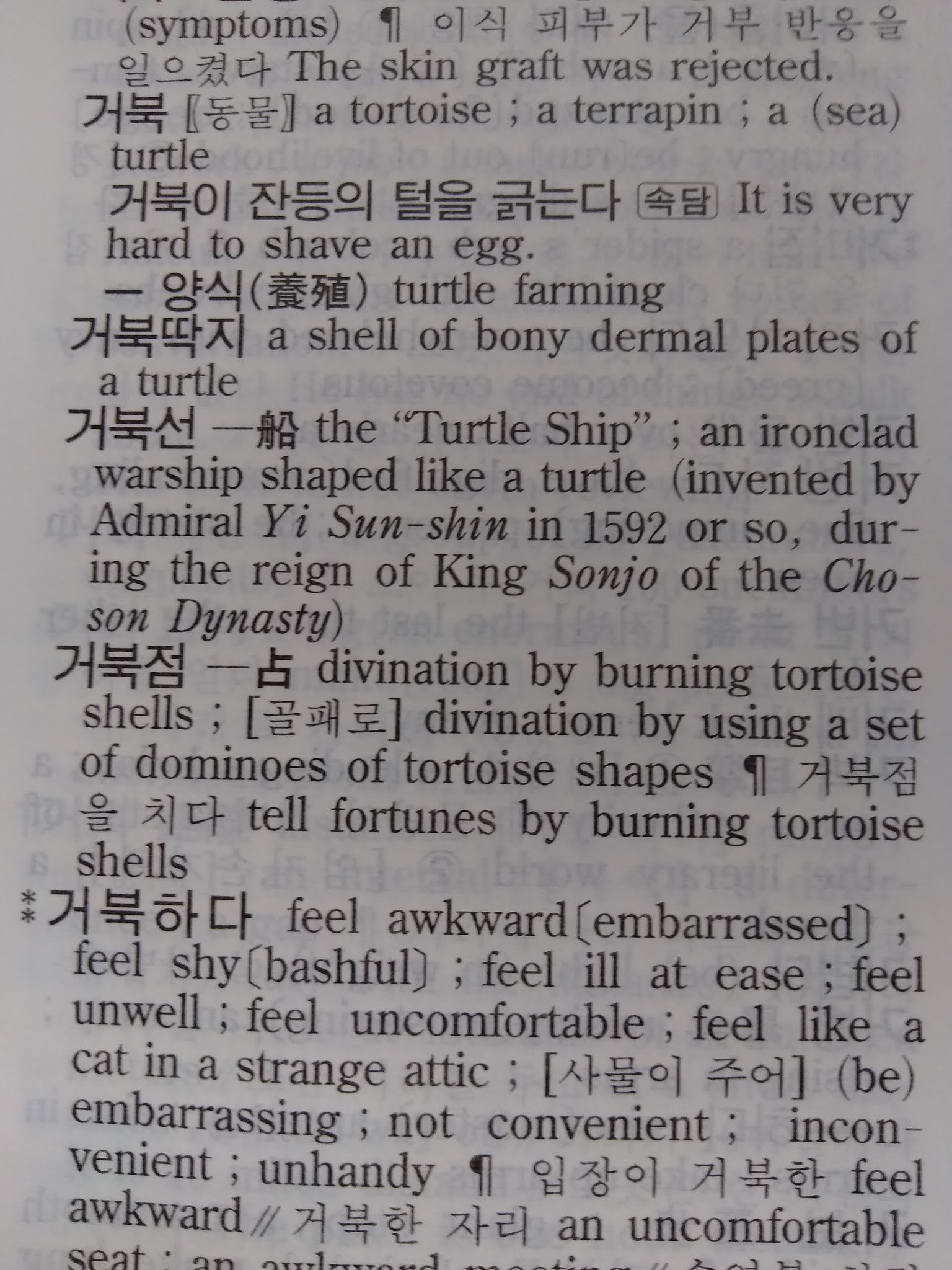
My Korean-English dictionary says that the Korean word for "turtle" is 거북, not "거북이," but in the Korean proverb listed together with the definition of 거북 the word 거북이 is used instead of 거북.
"거북이 잔등의 털을 긁는다."
"It is very hard to shave an egg."
The above translation of the Korean proverb is not a literal translation. Here is the literal translation:
"A turtle is scratching the hair on its back."
One of the problems with many Korean-English dictionaries is that they seem to be written for Koreans, not for foreigners. If my dictionary, for example, had been written for foreigners, then wouldn't it have also given the literal translation of the Korean proverb?
Anyway, why does my dictionary list 거북 as the Korean word for "turtle" and then use the word 거북이 for "turtle" in the proverb? Or is the 이 in 거북이 just the subject marker?
I have read that 거북 and 거북이 both mean "turtle" but that even though 거북 is more commonly found in dictionaries, 거북이 is more commonly used by Koreans.
I have not read this anywhere, but it seems the word 거북이 may come from the Korean adjective 거북하다, which means "to feel shy" or "awkward." Or maybe the adjective 거북하다 came from the Korean word for "turtle"?
Since turtles hide inside their shells when they are approached, they appear to be "shy," so 거북이 may literally mean "a shy animal" since the suffix 이 can mean "animal," "person," or "thing."
If true, then 거북하다 could translate as "turtlelike."